Saturday, May 8, 2010
Footstompin'/Wish I Could Shimmy Like My Sister Kate
via Zamboni
Is there a DVD collection of musical guests from the Dick Cavett show? There are some amazing performances to be had there.
I had heard this 1974 performance before (on the poorly put together but indispensable RarestOneBowie comp), but never seen it. The obviously exciting thing about this recording is that the opening guitar riff (which is pretty much completely unrelated to The Flares' original version of the song) ended up being used, almost identically, for "Fame" the following year. As the Baronette has frequently pointed out to me, Carlos Alomar is one of the best, most inventive rhythm guitarists of all time, despite the fact that no one ever really talks about him.
A few other things I'd like to mention:
This is by far the roughest I've ever heard Bowie's voice sound, and I've heard his voice sound a lot of different ways in different recordings dating from anywhere in the past forty-six years. It sounds amazing, and it's a very different kind of amazing than the usual Bowie amazing.
Check out Ava Cherry's wonderful dancing (and skirt! and jacket! and hair! and beauty!), first seen at about 1:39 and then visible again (first only as a shadow) starting at 2:38. (If you want to see her do more, like, say, sing, there's also the performance of "Young Americans" from the same episode.)
And finally, it's just a little minor accidental detail, but: I am absolutely in love with how the very first clap from the audience at the end is perfectly in rhythm with the foot stompin' that ends the song.
And now that I've discussed how damned enjoyable the music is, let's have some dull social analysis.
The whole Young Americans period (and the fantastic* album itself) is an interesting chapter in the white people stealing Black music story. Judging from interviews at the time** (or actually just after), Bowie was consciously, explicitly toying with the narrative; he seems to take a perverse joy in pointing out that just a few years prior this album could never have been considered "soul" and talking about how "dangerous" disco is--and yet how much he loves it--less than a year after "Fame" was his biggest hit. Young Americans, he says, is "the squashed remains of ethnic music as it survives in the age of Muzak*** rock, written and sung by a white limey." And it's true. And yet many seriously respectable "ethnic" musicians--Luther Vandross, for example--took part in its creation. And yet, again, it is fantastic music. The best possible reaction to this music, if we're being responsible, is ambivalence, but I am incapable of doing anything other than embracing it wholeheartedly.
With Young Americans, Bowie secured the complicity of Black and white alike on both the side of performer (Lennon and Vandross, remember; and Carlos Alomar was poached from the house band at The Apollo) and audience, all the while reminding everyone that what he was doing was in fact racist theft. I honestly can't decide if this is reprehensible or admirable. It's definitely impressive.
That it all happened right around the same time as his notorious obsession with fascism and Nazi mysticism makes it all the more fascinating.
*Barring the inexplicably awful cover of "Across the Universe" in which John Lennon himself participated and which is nonetheless unlistenable.
**Though of course you can never rely too much on Bowie interviews; there's another more recent one where he says the primary thing his fans pay him to do is lie to them. Speaking as an embarrassingly huge fan, I can't say he's wrong.
***The mention of Muzak, incidentally, is interesting, coming as it does in this period just a few months before he begins working intensively with Brian Eno, who is, essentially, the inventor of ambient music. Ambient and Muzak are of course not the same thing, but there is a very strong relationship.

Samuel R. Delany, Dhalgren, several excerpts
(cross-posted from Commonplace)
"Why do you stay?"
"Stay?" Loufer's voice neared that other, upsetting tone. "Well, actually, I've thought about that one a lot. I think it has to do with--I got a theory now--freedom. You know, here (...) you're free. No laws: to break, or to follow. Do anything you want. Which does funny things to you. Very quickly, surprisingly quickly, you become (...) exactly who you are."
-page 20
"It's funny," Tak said; they passed between. "You show me a place where they tell women to stay out of at night because of all the nasty, evil men lurking there to do nasty, evil things; and you know what you'll find?"
"Queers."
-page 21
Equipped with contradictory visions, an ugly hand caged in pretty metal, I observe a new mechanics. I am the wild machinist, past destroyed, reconstructing the present.
-page 24
"Why do you stay?"
"Stay?" Loufer's voice neared that other, upsetting tone. "Well, actually, I've thought about that one a lot. I think it has to do with--I got a theory now--freedom. You know, here (...) you're free. No laws: to break, or to follow. Do anything you want. Which does funny things to you. Very quickly, surprisingly quickly, you become (...) exactly who you are."
-page 20
"It's funny," Tak said; they passed between. "You show me a place where they tell women to stay out of at night because of all the nasty, evil men lurking there to do nasty, evil things; and you know what you'll find?"
"Queers."
-page 21
Equipped with contradictory visions, an ugly hand caged in pretty metal, I observe a new mechanics. I am the wild machinist, past destroyed, reconstructing the present.
-page 24
Friday, May 7, 2010
Monday, May 3, 2010
Tracings and trajectories of consumerist boredom
If you're not reading Pruned, you should be. Take this post, whose subject is essentially the psychogeography of IKEA:

Next door, meanwhile, a fellow employee is also busy crunching numbers. This rogue among rogues has been tasked to weaponize the work of his colleagues, to design an IKEA store as simulant city in which one could trap would-be occupiers and confuse them with self-knotting streams of generic spaces, a labyrinth within labyrinths, until they can be neutralized.I've often thought I could write whole shelves of books about IKEA, but aside from the bit about the sense of false accomplishment ("I made something!") conferred by putting together one of their prefab units, this short post by Alexander Trevi pretty much covers it all.
Thursday, April 29, 2010
Drapetomania
I have nothing to say about it, I just wanted to call attention to it for anyone who might have been as unaware of it as I was. Scientific racism at its finest.
Also: relevance to contemporary society? Discuss.
Also: relevance to contemporary society? Discuss.
Wokka wokka wokka
via Poumista
Mostly posting this to prove that that last post wasn't a suicide note, despite the days of silence following it.
Monday, April 26, 2010
Walter M. Miller, A Canticle for Leibowitz page 128
(Cross-posted from Commonplace)
When you tire of living, change itself seems evil, does it not? for then any change at all disturbs the deathlike peace of the life-weary.
When you tire of living, change itself seems evil, does it not? for then any change at all disturbs the deathlike peace of the life-weary.
Sunday, April 25, 2010
Glen AND Glenda
From Science News: Chicken cells have strong sense of sexual identity.
Basically, a study of a rare but naturally occurring developmental oddity in chickens that results in animals bilaterally divided into male and female (seriously, look at the picture) has found that male and female cells are scattered throughout the body, male dominating one side and female dominating the other, regardless of the hormonal signals that previously were thought to override this cellular sex.
*Though of course hormones do have a huge, demonstrable effect that no amount of scientific findings about cellular sex can take away, and knowing more about this stuff can only help the hormones to be more effective.
Basically, a study of a rare but naturally occurring developmental oddity in chickens that results in animals bilaterally divided into male and female (seriously, look at the picture) has found that male and female cells are scattered throughout the body, male dominating one side and female dominating the other, regardless of the hormonal signals that previously were thought to override this cellular sex.
Subsequent experiments supported the idea of strong, cell-by-cell sex identity. When the researchers transplanted tissues from genetically female embryos into what would become the gonads of genetically male ones and vice versa, the transplanted cells didn’t start expressing opposite-sex characteristics.In some ways this seems like it could be a bit disheartening for humans using hormone therapy as part of a transition process*, but to me, taken together with a lot of other research (like the experiment I pointed out a while back in which female mice were turned into male mice by switching one gene), I find this fantastic. It's yet another scientific finding chipping away at the notion we have that sex is a simple binary, and yet another encouraging sign that we may eventually have far greater control over how our bodies reflect gender than we do now.
In combination with other recent papers, says UCLA geneticist Art Arnold, the new study calls for fresh thinking about sex determination, and not just in birds. “The old hormone-only theory is no longer viable, for birds or mammals,” he says.
*Though of course hormones do have a huge, demonstrable effect that no amount of scientific findings about cellular sex can take away, and knowing more about this stuff can only help the hormones to be more effective.
Further quickies
I have plenty of things I want to write about but no inclination to do so right now. So for now here's another quick thing:
The spectacle (not The Spectacle) of people chaining themselves to the White House fence to fight for the right to serve the State in the most devoted way possible is, uh, troubling.
The spectacle (not The Spectacle) of people chaining themselves to the White House fence to fight for the right to serve the State in the most devoted way possible is, uh, troubling.
Friday, April 23, 2010
This is easy
Haven't much felt like writing recently, but criticizing PZ Myers is easy so here goes:
Hey, you reprehensible idiot.
The "idiots of Islam can rely on intimidation and fear to silence their critics"? Do you have any idea what is going on in this real world you claim to care about so much?
Hey, you reprehensible idiot.
The "idiots of Islam can rely on intimidation and fear to silence their critics"? Do you have any idea what is going on in this real world you claim to care about so much?
Monday, April 19, 2010
THIS IS A SERIOUS DANGER!!!
Apple needs to get out of the censorship game. Review apps for compatibility, but not content; it's OK if Apple will only market neutered, innocuous apps through their branded store, but not OK if they use their tech to restrict access and allow no other app outlets.This is a serious enough danger that I've decided to put off any purchase of an iPad until I see some resolution of this problem. Unlock the apps.
Unlock the apps! This is so serious that I might not buy something yet!
UPDATE: Tristero is reliably hilarious. The gist: whoa, Apple is evil! But come on now, not buying an iPad? Why, that's sedition!
The things I don't know
Sometimes when I learn something that startles me and helps to explain a lot of the way things work, I'm unsure of how important it is to share the discovery, because I have no idea if it's just me being ignorant or if it's genuinely something most people don't know.
For example, about six months ago when I read Assata, the autobiography of Assata Shakur and one of the best books I've ever read, I was startled to learn that the 13th Amendment to the Constitution explicitly allows slavery in one case:
Now I know. Prisoners are slave laborers. Not metaphorically, literally.
(An aside: right now I'm finding it useful to think of the 13th Amendment not as abolishing slavery so much as changing it from a private system to a government one. The mixed public-private incarceration system that we're seeing now is essentially a symptom of the accelerating melding of the public and the private.)
And a related thing I just learned about in Are Prisons Obsolete? is the "convict lease" program, instituted in the wake of the 13th Amendment, in which, as the name of the program indicates, convicts could be leased for labor. The especially neat thing about this is that after the end of slavery, the Black prison population in formerly slave areas shot up dramatically. After all, imprisonment is the punishment of the individual by taking away his or her rights; under slavery, Black people had no rights, so their punishment took other forms. Now that Black people at least theoretically had rights, they could be taken away--and not only that, but the lawmakers set about making all kinds of things illegal specifically so that Black people could be "duly convicted" of them.
So you've got these suddenly primarily Black prisoners available for "lease." You purchase the right to use them for a month for some fee. As Angela Davis points out, this often led to worse treatment than under slavery, because when you own a slave you have an investment in them, and don't want to work them to death because then you have to go buy another one. With leasing, there's no reason not to work them to death, because you can just go lease another one, which you would have done anyway.
According to wikipedia, the "system was slowly phased out in the early 20th century, with Alabama being the last state to outlaw the practice in 1928." Which is awfully recent for something so completely horrific, so intensely brutal, to have happened and been entirely forgotten.
And of course there is still a vast, and exponentially increasing, sea of Black (and other shade) bodies in prison being used for profit to this day.
For example, about six months ago when I read Assata, the autobiography of Assata Shakur and one of the best books I've ever read, I was startled to learn that the 13th Amendment to the Constitution explicitly allows slavery in one case:
Neither slavery nor involuntary servitude, except as a punishment for crime whereof the party shall have been duly convicted, shall exist within the United States, or any place subject to their jurisdiction.Which made a lot of things make sense that hadn't before. Or more accurately, fully explained things that I hadn't realized didn't make sense. Like, before I learned about that, I thought the existence of private prisons was the entire justification for all the increased incarceration of the past few decades, despite the fact that private prisons actually account for only a small percentage of the totality of the American prison landscape, and despite the fact that I didn't have a clear concept of how incarceration led to profit. I just hadn't thought it through.
Now I know. Prisoners are slave laborers. Not metaphorically, literally.
(An aside: right now I'm finding it useful to think of the 13th Amendment not as abolishing slavery so much as changing it from a private system to a government one. The mixed public-private incarceration system that we're seeing now is essentially a symptom of the accelerating melding of the public and the private.)
And a related thing I just learned about in Are Prisons Obsolete? is the "convict lease" program, instituted in the wake of the 13th Amendment, in which, as the name of the program indicates, convicts could be leased for labor. The especially neat thing about this is that after the end of slavery, the Black prison population in formerly slave areas shot up dramatically. After all, imprisonment is the punishment of the individual by taking away his or her rights; under slavery, Black people had no rights, so their punishment took other forms. Now that Black people at least theoretically had rights, they could be taken away--and not only that, but the lawmakers set about making all kinds of things illegal specifically so that Black people could be "duly convicted" of them.
So you've got these suddenly primarily Black prisoners available for "lease." You purchase the right to use them for a month for some fee. As Angela Davis points out, this often led to worse treatment than under slavery, because when you own a slave you have an investment in them, and don't want to work them to death because then you have to go buy another one. With leasing, there's no reason not to work them to death, because you can just go lease another one, which you would have done anyway.
According to wikipedia, the "system was slowly phased out in the early 20th century, with Alabama being the last state to outlaw the practice in 1928." Which is awfully recent for something so completely horrific, so intensely brutal, to have happened and been entirely forgotten.
And of course there is still a vast, and exponentially increasing, sea of Black (and other shade) bodies in prison being used for profit to this day.
Sunday, April 18, 2010
More on Playtime
Following up on the Baronette's typically brief post on Tati's Playtime, I wanted to be wordier about it.
When people talk about Jacques Tati, they usually just talk kind of vaguely about the alienation of modern life and technology. Which, you know, sure. But Playtime is much much more than that. Most of the running time is, to be sure, about alienation in modern surroundings. And before I even get to my big but about that I want to point out the smaller but that even this alienation is presented with such a degree of playfulness and exhilaration that tells you that Tati's not wandering through this alienation anywhere near as helplessly as his Monsieur Hulot is. The characters in the movie might have emotions ranging from not-unhappy downwards, but the movie itself is filled with joy.
Towards the end of the film we find out explicitly where it comes from, and it's my big but. In an extended sequence, a brand-new ultra-modern nightclub starts getting customers before it's even done being constructed, and then people keep piling in in larger and larger numbers and before long they've literally torn the place to pieces. And as they destroy and remake the modern world they're in, they suddenly become absolutely, uproariously joyous, and dance and drink and laugh into the morning.
And then, here's the great part: the rest of the movie keeps that mood. They're back out into surroundings they haven't remade for themselves, surroundings that just yesterday (just about fifteen minutes ago in screen time) were harsh and alien, but the joy remains. These people have figured out how to take the surroundings they're given and use them for their own purposes, rather than how the places signal them to use them.
Or, as Jonathan Rosenbaum put it (as I see him quoted by Roger Ebert), Playtime
When people talk about Jacques Tati, they usually just talk kind of vaguely about the alienation of modern life and technology. Which, you know, sure. But Playtime is much much more than that. Most of the running time is, to be sure, about alienation in modern surroundings. And before I even get to my big but about that I want to point out the smaller but that even this alienation is presented with such a degree of playfulness and exhilaration that tells you that Tati's not wandering through this alienation anywhere near as helplessly as his Monsieur Hulot is. The characters in the movie might have emotions ranging from not-unhappy downwards, but the movie itself is filled with joy.
Towards the end of the film we find out explicitly where it comes from, and it's my big but. In an extended sequence, a brand-new ultra-modern nightclub starts getting customers before it's even done being constructed, and then people keep piling in in larger and larger numbers and before long they've literally torn the place to pieces. And as they destroy and remake the modern world they're in, they suddenly become absolutely, uproariously joyous, and dance and drink and laugh into the morning.
And then, here's the great part: the rest of the movie keeps that mood. They're back out into surroundings they haven't remade for themselves, surroundings that just yesterday (just about fifteen minutes ago in screen time) were harsh and alien, but the joy remains. These people have figured out how to take the surroundings they're given and use them for their own purposes, rather than how the places signal them to use them.
Or, as Jonathan Rosenbaum put it (as I see him quoted by Roger Ebert), Playtime
directs us to look around at the world we live in (the one we keep building), then at each other, and to see how funny that relationship is and how many brilliant possibilities we still have in a shopping-mall world that perpetually suggests otherwise; to look and see that there are many possibilities and that the play between them, activated by the dance of our gaze, can become a kind of comic ballet, one that we both observe and perform.This is why the Baronette says it's nice to learn that Debord loved the movie. It could just as well have been called Psychogeography: The Movie. Except of course that that would take probably the single most wonderfully joyful movie I've ever seen and make it sound kind of dry and intellectual. Which it completely is not. I've seriously never had so much fun watching a movie, nor have I ever been so inspired to face the world differently by a movie.
you know it
good to know that guy debord was a fan of jacques tati's "Play Time". that would have been downright silly of him to think otherwise.
Thursday, April 15, 2010
Why Godwin's Law is the stupidest goddamn thing ever
I would like to call attention to the last of the excerpts from Are Prisons Obsolete? that I just posted, in which medical experiments performed on American prisoners between World War II and 1974 are glancingly described.
Medical experiments on captive populations. If you, like me, are a recovering liberal and still in the back of your mind keeping a list of things the U.S. hasn't done recently that make us* in some way better than the Nazis, you can cross that one off.
*"Us" in the sense of "me and a group of people that may or may not include some of the people I'm speaking to." I wish English could distinguish between "me and you" us and "me and them" us.
Medical experiments on captive populations. If you, like me, are a recovering liberal and still in the back of your mind keeping a list of things the U.S. hasn't done recently that make us* in some way better than the Nazis, you can cross that one off.
*"Us" in the sense of "me and a group of people that may or may not include some of the people I'm speaking to." I wish English could distinguish between "me and you" us and "me and them" us.
Angela Y. Davis, Are Prisons Obsolete? several excerpts
(Cross-posted from Commonplace)
[T]he prison sentence, which is always computed in terms of time, is related to abstract quantification, evoking the rise of science and what is often referred to as the Age of Reason. We should keep in mind that this was precisely the historical period when the value of labor began to be calculated in terms of time and therefore compensated in another quantifiable way, by money. The computability of state punishment in terms of time--days, months, years--resonates with the role of labor-time as the basis for computing the value of capitalist commodities. Marxist theorists of punishment have noted that precisely the historical period during which the commodity form arose is the era during which penitentiary sentences emerged as the primary form of punishment.
-page 44
[C]onvicts punished by imprisonment in emergent penitentiary systems were primarily male. This reflected the deeply gender-biased structure of legal, political, and economic rights. Since women were largely denied public status as rights-bearing individuals, they could not be easily punished by the deprivation of such rights through imprisonment.
-page 45
It was during the decade of the 1980s that corporate ties to the punishment system became more extensive and entrenched than ever before. But throughout the history of the U.S. prison system, prisoners have always constituted a potential source of profit. For example, they have served as valuable subjects in medical research...
During the post-World War II period, for example, medical experimentation on captive populations helped to hasten the development of the pharmaceutical industry...
By the time the experimentation program was shut down in 1974 and new federal regulations prohibited the use of prisoners as subjects for academic and corporate research, numerous cosmetics and skin creams had already been tested. Some of them had caused great harm to these subjects and could not be marketed in their original form. Johnson and Johnson, Ortho Pharmaceutical, and Down Chemical are only a few of the corporations that reaped great material benefits from these experiments.
-pages 88-90
[T]he prison sentence, which is always computed in terms of time, is related to abstract quantification, evoking the rise of science and what is often referred to as the Age of Reason. We should keep in mind that this was precisely the historical period when the value of labor began to be calculated in terms of time and therefore compensated in another quantifiable way, by money. The computability of state punishment in terms of time--days, months, years--resonates with the role of labor-time as the basis for computing the value of capitalist commodities. Marxist theorists of punishment have noted that precisely the historical period during which the commodity form arose is the era during which penitentiary sentences emerged as the primary form of punishment.
-page 44
[C]onvicts punished by imprisonment in emergent penitentiary systems were primarily male. This reflected the deeply gender-biased structure of legal, political, and economic rights. Since women were largely denied public status as rights-bearing individuals, they could not be easily punished by the deprivation of such rights through imprisonment.
-page 45
It was during the decade of the 1980s that corporate ties to the punishment system became more extensive and entrenched than ever before. But throughout the history of the U.S. prison system, prisoners have always constituted a potential source of profit. For example, they have served as valuable subjects in medical research...
During the post-World War II period, for example, medical experimentation on captive populations helped to hasten the development of the pharmaceutical industry...
By the time the experimentation program was shut down in 1974 and new federal regulations prohibited the use of prisoners as subjects for academic and corporate research, numerous cosmetics and skin creams had already been tested. Some of them had caused great harm to these subjects and could not be marketed in their original form. Johnson and Johnson, Ortho Pharmaceutical, and Down Chemical are only a few of the corporations that reaped great material benefits from these experiments.
-pages 88-90
Earn Enough for Us
There's not much to say about this song, which is simple-minded enough to speak for itself, so I'm not going to pull a repeat of the Baronette's "Drunken Maria" post from last night. I'm just enjoying it right now. I love the prechorus melody ("Glad that you want to be my wife, but honest...").
Twibrary of Blogress
The dismissive tone of this short post mentioning the Library of Congress's plans to archive twitter posts (or twosts), and the far more dismissive tone of most of the comments on it, irritates me. I'm not going to make any kind of claim that twitter is creating revolutionary social change or any kind of great literature or anything of the kind (though it may be doing that, who knows), but the idea that there can be no value in recording these things amounts to the idea that there is no value in the thoughts and actions of everyday people.
What is unprecedented with twitter and with blogs and so on is not so much the fact that the masses (and yes, I know that it's a limited, generally privileged slice of the masses) have things to say and are saying them as that they/we now have a platform to say these things and have them recorded and accessible to anyone (the word "anyone" carrying the same restrictions I mentioned before) who wants to read them, irrespective of the ability of these thoughts to sell commodities, and irrespective of the monetary value of the thinker. To dismiss all of this as narcissistic navel gazing, regardless of whether or not much of it is narcissistic navel gazing, is insulting and, I would argue, elitist in a way that is very useful to power.
What is unprecedented with twitter and with blogs and so on is not so much the fact that the masses (and yes, I know that it's a limited, generally privileged slice of the masses) have things to say and are saying them as that they/we now have a platform to say these things and have them recorded and accessible to anyone (the word "anyone" carrying the same restrictions I mentioned before) who wants to read them, irrespective of the ability of these thoughts to sell commodities, and irrespective of the monetary value of the thinker. To dismiss all of this as narcissistic navel gazing, regardless of whether or not much of it is narcissistic navel gazing, is insulting and, I would argue, elitist in a way that is very useful to power.
Wednesday, April 14, 2010
Drunken Maria
the Monks often seem beyond belief to me. they achieve genuine unease through the filter of absolute mania. no other band can sound this joyous and menacing simultaneously. (i will admit that there are some that come very close though.) another thing that fuels my astonishment is that this music predates The Velvet Underground & Nico. a lot of garage rock was bold, but not like this.
take a song like "drunken maria" from their album Black Monk Time. under two minutes a scene of forced nihilism is shaped with unquestionable glee. in alternating commands - "sleepy maria, don't drink!" "drunken maria, don't sleep!" - they not only define this girl's existence, they deny her of it!
dadaist strains ran all through their music. (the chorus of their song "shut up" contains the absolutely brilliant line, "be a liar everywhere.") with that in mind, a dimension of "drunken maria" is revealed. this jaunty, little pop song is no less than a reaction aimed straight at the heart of the prevailing culture - a reaction which feels no need for a distinction between sincerity and insincerity. and why should it cater to this world? especially when it's laid down like this.
i may post more about the Monks in the future. the impact they continue to have on me is immeasurable. if you haven't heard Black Monk Time, check it out. i'll end here to keep things brief. that's it!


Tuesday, April 13, 2010
People who should know better
Angela Y. Davis, Are Prisons Obsolete?:
One of the grave consequences of the powerful reach of the prison was the 2000 (s)election of George W. Bush as president. If only the black men and women denied the right to vote because of an actual or presumed felony record had been allowed to cast their ballots, Bush would not be in the White House today. And perhaps we would not be dealing with the awful costs of the War on Terrorism declared during the first year of his administration. If not for his election, the people of Iraq might not have suffered death, destruction, and environmental poisoning by U.S. military forces.
I hate to be critical of this book, because though I'm not very far into it and she's still making her background arguments, it's already extremely useful and clearly very important. But this is an unambiguous example of a problem I've noticed throughout the text thus far: passive democratic partisanship. While detailing the prison building boom that we've been going through since the 1980s, she mentions Reagan and both Bushes by name several times, with no mention of Clinton, under whose presidency the trend towards mass imprisonment only accelerated. Surely of all people Angela Davis shouldn't fall for this nonsense.
I know from seeing her speak a few years back that she had no illusions about Obama well before he was elected. And it's entirely possible that this is a rhetorical gambit, one intended to draw in liberals who might be at least somewhat sympathetic to her arguments but would be alienated by criticisms of democrats early on. If this is the case, I hope she addresses it at some point in the remainder of the book.
Monday, April 12, 2010
Recommendation
If you're interested in any of these things:
-guilt, both as an emotion and as a fact
-imperialism and its effect on both the colonized and the colonizer
-how the failings of the society express themselves as the failings of the individual
-privilege and the insecurity it breeds
-long stretches of silence
-ambiguity
-movies
and you haven't seen Michael Haneke's brilliant Caché, I suggest you remedy that.
-guilt, both as an emotion and as a fact
-imperialism and its effect on both the colonized and the colonizer
-how the failings of the society express themselves as the failings of the individual
-privilege and the insecurity it breeds
-long stretches of silence
-ambiguity
-movies
and you haven't seen Michael Haneke's brilliant Caché, I suggest you remedy that.
Survival of the oppressive fittest
I don't really know much about Naomi Wolf, but I just happened across this quote of hers, which I had seen before and I think is fairly famous:
There is a particular argument that people commonly make against accurate descriptions of oppression in the form of Wolf's above (i.e., the form "this widely accepted fact of life in our society functions remarkably well to keep us from opposing or even noticing our own oppression"). When I saw this quote today it even lept, briefly, unbidden, to my mind, whereupon I had to exert an effort (a minimal effort, but an effort nonetheless) to banish it, which tells me it embedded deeply enough in my culture to be a part of my subconscious, which sucks. The argument goes something like this: "Oh come on. Do you really think there's there are a bunch of men sitting around in a room somewhere making the decision to inflict dieting on women just to keep them down?"
And, well. With this specific case there kind of is, considering that there's a beauty industry. So I guess that was a bad example. But even admitting this, many would make the argument "Well, maybe some women are affected that way, but it's not like anyone's doing it deliberately."
I have two thoughts about that.
First, intent doesn't matter. The effect does. The logic is similar to the common liberal "We're killing you for your own good" argument for war. Regardless of whether or not the people in charge of the beauty industry are sitting around in smokey back rooms twirling their mustaches and cackling about oppressing women, the fact remains that in real life women are oppressed by the things they do.
Second, and this is my main point regardless of how frickin' long it took me to get to it, you could see concepts like unattainable beauty as being the product of a process of Darwinian evolution. Human beings, moving around in their predictable/unpredictable ways, interacting and forming societies, inevitably create all kinds of ideas and cultural norms and aphorisms and expectations. These are often the specific creation of individuals that end up being popular, and also are often the result of mixing and matching all kind of pieces originating from different groups of people; either way, the rise to relevance is largely random.
But there are selective pressures. And in a capitalist, rigidly class-stratified culture like the one we've got, the overwhelmingly strongest of these pressures come from the interests of power. The big money system sees all these ideas percolating around. It sees some of them getting more popular. And it evaluates them for usefulness. Those that are useful--those that are immediately profitable, those which will perpetuate the system--get shitloads of money thrown at them. Those that are not do not or, worse, get money thrown at their opposites. In this way, the ideas that are useful to power survive and reproduce and spawn new ideas in new heads that are also useful to power, while those that are either useless or against power tend to die off before having much of an impact.
So it is that we have all these well-financed cultural messages telling women that they need to diet themselves into insanity, and spend an hour getting ready for work for every minute that a man spends doing the same. In this way women are driven to consume lots of products and to be unable to form useful opposition. Similarly, we're told over and over again by power that, say, money can't buy happiness and we're all much better off without it. And at the same time that poor people are poor because they're lazy. And at the same time that you should avoid looking poor by buying lots of expensive products. And so on and so on.
At the level of individuals, this mechanism mostly takes the form of people making marketing decisions based on what will keep them their own jobs. The ones who are good at picking the right ideas and trends to put money into keep their jobs long enough to keep doing it over and over again. And they do keep doing it, because in so doing they not only keep their jobs--they advance their careers. They know they have to advance their careers because there are a lot of well-financed messages telling them they have to. So, regardless of whether the smokey backrooms of villainy actually exist (and I believe that at least some of them do), the system knows how to perpetuate itself.
Dieting is the most potent political sedative in women’s history; a quietly mad population is a tractable one.I think she kind of overstates her case with that "most" there, but aside from that minor quibble (one I really have no right to make, considering the frequency of my own case-overstating) it's an excellent observation. The need for women to adhere to unreachable and irrelevant standards of beauty is a huge obstacle to their achieving equality even in, say, the repressive exploitation of wage slavery, let alone any other aspect of life.
There is a particular argument that people commonly make against accurate descriptions of oppression in the form of Wolf's above (i.e., the form "this widely accepted fact of life in our society functions remarkably well to keep us from opposing or even noticing our own oppression"). When I saw this quote today it even lept, briefly, unbidden, to my mind, whereupon I had to exert an effort (a minimal effort, but an effort nonetheless) to banish it, which tells me it embedded deeply enough in my culture to be a part of my subconscious, which sucks. The argument goes something like this: "Oh come on. Do you really think there's there are a bunch of men sitting around in a room somewhere making the decision to inflict dieting on women just to keep them down?"
And, well. With this specific case there kind of is, considering that there's a beauty industry. So I guess that was a bad example. But even admitting this, many would make the argument "Well, maybe some women are affected that way, but it's not like anyone's doing it deliberately."
I have two thoughts about that.
First, intent doesn't matter. The effect does. The logic is similar to the common liberal "We're killing you for your own good" argument for war. Regardless of whether or not the people in charge of the beauty industry are sitting around in smokey back rooms twirling their mustaches and cackling about oppressing women, the fact remains that in real life women are oppressed by the things they do.
Second, and this is my main point regardless of how frickin' long it took me to get to it, you could see concepts like unattainable beauty as being the product of a process of Darwinian evolution. Human beings, moving around in their predictable/unpredictable ways, interacting and forming societies, inevitably create all kinds of ideas and cultural norms and aphorisms and expectations. These are often the specific creation of individuals that end up being popular, and also are often the result of mixing and matching all kind of pieces originating from different groups of people; either way, the rise to relevance is largely random.
But there are selective pressures. And in a capitalist, rigidly class-stratified culture like the one we've got, the overwhelmingly strongest of these pressures come from the interests of power. The big money system sees all these ideas percolating around. It sees some of them getting more popular. And it evaluates them for usefulness. Those that are useful--those that are immediately profitable, those which will perpetuate the system--get shitloads of money thrown at them. Those that are not do not or, worse, get money thrown at their opposites. In this way, the ideas that are useful to power survive and reproduce and spawn new ideas in new heads that are also useful to power, while those that are either useless or against power tend to die off before having much of an impact.
So it is that we have all these well-financed cultural messages telling women that they need to diet themselves into insanity, and spend an hour getting ready for work for every minute that a man spends doing the same. In this way women are driven to consume lots of products and to be unable to form useful opposition. Similarly, we're told over and over again by power that, say, money can't buy happiness and we're all much better off without it. And at the same time that poor people are poor because they're lazy. And at the same time that you should avoid looking poor by buying lots of expensive products. And so on and so on.
At the level of individuals, this mechanism mostly takes the form of people making marketing decisions based on what will keep them their own jobs. The ones who are good at picking the right ideas and trends to put money into keep their jobs long enough to keep doing it over and over again. And they do keep doing it, because in so doing they not only keep their jobs--they advance their careers. They know they have to advance their careers because there are a lot of well-financed messages telling them they have to. So, regardless of whether the smokey backrooms of villainy actually exist (and I believe that at least some of them do), the system knows how to perpetuate itself.
My new working definition of classical music
The genre in which works with known composers can be performed by people other than those composers, and no one will ever complain about it.
Sunday, April 11, 2010
So weird
Following some links around from articles at the Punkass Blog, I stumbled, as I occasionally do, onto a feminist* blog that holds a vicious, psychotic hatred of transgender people. As usual when this happens, I'm filled with a strong urge to post a comment saying "You're absurdly hate-filled and have no idea what you're talking about," but I never do, because really what's the point?
My only reason for posting this right now is to say: huh?!?
I completely understand, though I disagree (somewhat selfishly, somewhat not), when some feminists' rage against men is indiscriminate and vehement. It is hard to be understanding when the entire class of human beings you belong to is oppressed by an entire other class. But what the hell did transgender people do to these feminists?
And it's a really bizarre kind of hatred, too. Or, rather, a bizarre kind of hatred for people calling themselves feminists to engage in. In the post and in the comments, all kinds of attitudes come out that I bet the people writing would immediately recognize as absurd if other people made them about any other group. In the original post, the writer says that transwomen should "try addressing the problem of rape and the men they are afraid will rape them, if they use the mensroom. but they never do," as though it was the responsibility of the victim to fix the victimizer. Or this from one of the comments (which gets an approving response from the original poster): "This would be funny if you weren’t right about trans women being MRAs. One of them even admitted it." One of them??? Hey, once I met a woman who lured men in with her looks and then crushed them! All women do that! Once I met a Black person who stole! All Black people do that! Are you fucking kidding me?
*I'm tempted to say "feminist" in quotation marks, but I don't want to be one of those people who defines "feminist" as "someone who agrees with me on everything."
**Another of those times when the possessive is insultingly inaccurate.
WOW: This post is awkwardly written. I might copyedit later. The content won't change, but the wording might a bit. Just, you know, a warning.
My only reason for posting this right now is to say: huh?!?
I completely understand, though I disagree (somewhat selfishly, somewhat not), when some feminists' rage against men is indiscriminate and vehement. It is hard to be understanding when the entire class of human beings you belong to is oppressed by an entire other class. But what the hell did transgender people do to these feminists?
And it's a really bizarre kind of hatred, too. Or, rather, a bizarre kind of hatred for people calling themselves feminists to engage in. In the post and in the comments, all kinds of attitudes come out that I bet the people writing would immediately recognize as absurd if other people made them about any other group. In the original post, the writer says that transwomen should "try addressing the problem of rape and the men they are afraid will rape them, if they use the mensroom. but they never do," as though it was the responsibility of the victim to fix the victimizer. Or this from one of the comments (which gets an approving response from the original poster): "This would be funny if you weren’t right about trans women being MRAs. One of them even admitted it." One of them??? Hey, once I met a woman who lured men in with her looks and then crushed them! All women do that! Once I met a Black person who stole! All Black people do that! Are you fucking kidding me?
*I'm tempted to say "feminist" in quotation marks, but I don't want to be one of those people who defines "feminist" as "someone who agrees with me on everything."
**Another of those times when the possessive is insultingly inaccurate.
WOW: This post is awkwardly written. I might copyedit later. The content won't change, but the wording might a bit. Just, you know, a warning.
Saturday, April 10, 2010
Five Dollar Friday
An excellent idea from Jon Schwartz. My first $5 are probably going to go to Arthur Silber, I'll see where to go after that. Sticking with Arthur wouldn't be a bad idea, either.
As I said at Jon's place, I plan to do this for as long as I can afford/remember to.
As I said at Jon's place, I plan to do this for as long as I can afford/remember to.
Pushing the penises down the page
Charles F. Oxtrot, for whom absolutely no one in the entire world is radical enough to be nice to, can often be kind of irritating, but he can also often be kind of right on:
I hope to work on one of my longer essays tomorrow, but you never know what that means with me.
ADDENDUM: I didn't intend, by the way, to imply any equivalence between the guns-at-town-halls-and-all-that-stuff people, who are goofy at best, and the Black Panthers, who are due all admiration. It's just that when I hear all this liberal screeching about guns in public places, I always think of the Panthers. From the comfort of our cup holders we can find guns as distasteful as we please, but when you've got heavily armed motherfuckers shooting at you and your friends every day for no damn reason, it's good to be able to show them that you could, if you chose, shoot back.
Fuckin' pantywaist urbane liberals fear guns like nobody's business. They want all dogs leashed, they want guns outlawed, but they'll drive their fucking SUVs in a distracted state through a neighborhood full of children and dogs, yakking on a cell phone while putting on makeup or drinking coffee, at 20mph over the speed limit, and that's okay.I have nothing to add, except that these liberals should maybe read some Black Panther literature if it's not too scary for them.
THE GUNS! THE UNLEASHED DOGS!
While they drive Death Race 2000 style, threatening all living creatures in their weaving, wobbling, unpredictable paths.
BUT HE BROUGHT A GUN TO A MEETING!
Jesus, talk about a disconnect from reality.
I hope to work on one of my longer essays tomorrow, but you never know what that means with me.
ADDENDUM: I didn't intend, by the way, to imply any equivalence between the guns-at-town-halls-and-all-that-stuff people, who are goofy at best, and the Black Panthers, who are due all admiration. It's just that when I hear all this liberal screeching about guns in public places, I always think of the Panthers. From the comfort of our cup holders we can find guns as distasteful as we please, but when you've got heavily armed motherfuckers shooting at you and your friends every day for no damn reason, it's good to be able to show them that you could, if you chose, shoot back.
Thursday, April 8, 2010

Wednesday, April 7, 2010


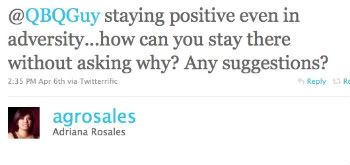
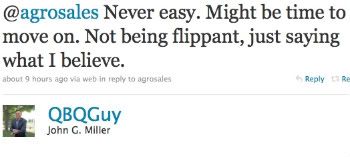
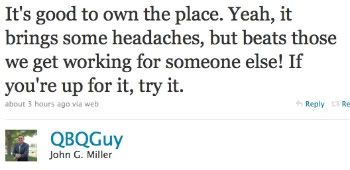
Another quickie
I see via Jack that Obama's happily begun publicly issuing his very own fatwas. Ha ha, whee!
Tuesday, April 6, 2010
Concrete
The nice thing about my job is that it's given me a specific dollars per hour figure for what my emotional devastation is really worth.
I have a few longer essays I'm working on. I might finish them sometimes when I can pull myself together.
I have a few longer essays I'm working on. I might finish them sometimes when I can pull myself together.
Monday, April 5, 2010
back with this
from the "Black Flame" book:
"Luigi Galleani (1861 - 1931)... added the point that the value of less tangible products, such as 'Pascal's theorem... Newton's law of gravitation, or... Marconi's wireless telegraphy' could scarcely be assessed, nor could the innovations of these men be separated from the ideas and discoveries of others."
what he's getting at is a recurring theme on this blabstand - one that i find to be immeasurably significant one at this juncture. this interconnectivity extends throughout so many orders of life, but we rarely consider it to be beyond commodification and exclusivity. (if it is considered at all.)
i mean, just think about how guarded the entire medical industry is.
"Luigi Galleani (1861 - 1931)... added the point that the value of less tangible products, such as 'Pascal's theorem... Newton's law of gravitation, or... Marconi's wireless telegraphy' could scarcely be assessed, nor could the innovations of these men be separated from the ideas and discoveries of others."
what he's getting at is a recurring theme on this blabstand - one that i find to be immeasurably significant one at this juncture. this interconnectivity extends throughout so many orders of life, but we rarely consider it to be beyond commodification and exclusivity. (if it is considered at all.)
i mean, just think about how guarded the entire medical industry is.
Sunday, April 4, 2010
WHAT IS GOING ON IN THIS HOUSE?!?!
Sarah, Leland, and Laura Palmer's house is for sale! The back of it doesn't look remotely like I would have imagined.
Saturday, April 3, 2010
Quickie
Jay Taber:
It is sad that liberal Americans are so gullible that they believed a totalitarian state would be accomplished under the reign of the idiot son of an aristocratic family, rather than by a slick-talking, well-marketed, black man from Wall Street.Lest anyone accuse me of quoting this pithy truth as a means of asserting my superiority, let me be clear: I certainly was one of those gullible liberals until embarrassingly recently.
More complaints about women in sci-fi TV
I just sat down to watch the first post-hiatus episode of FlashForward, because even though I mostly hate that show, it throws out enough cool sci-fi bits like "all the crows died at the same time" or "weird mysterious tower in the middle of Somalia and a big black cloud" or "the LHC did it," and enough really entertainingly batty moments like "main character lying on the ground shot and one of those alarm clocks with wheels rolling around in the puddle of blood" to keep me watching half-heartedly.
And I'm disappointed in myself for not even noticing this until ten episodes in, but the main characters' flashforwards are rigidly gender-segregated.
The men: One is in his FBI office dramatically figuring things out while masked people with guns hunt him down. One is searching for his daughter in war-torn Afghanistan (ugh). One is in a heated phone call about the fate of the world. One didn't have a flashforward, so, ooh, is he dead in the future?
The women: One is with a man who is not her husband. One is pregnant. One (it seems) is getting married. One is being drowned. And, uh...that's it.
And, OK, sure, it's not as cut and dry as all that. One of the men is on the toilet, ha ha. The daughter in Afghanistan (whose flashforward I don't believe we've seen) is a soldier. And then there are minor characters whose visions deviate from the standard set by the main characters.
But the overall pattern stands: the men are in action! They're doing world-shaping important things! The women are cheating on their husbands or getting married (or is she?) or being pregnant or being brutalized by men.
The show is also stupid in many other ways.
Also, if I were a TV show coming back from months of hiatus, I would find a better way to open the returning episode than with four minutes of almost unbroken shitty CGI.
And I'm disappointed in myself for not even noticing this until ten episodes in, but the main characters' flashforwards are rigidly gender-segregated.
The men: One is in his FBI office dramatically figuring things out while masked people with guns hunt him down. One is searching for his daughter in war-torn Afghanistan (ugh). One is in a heated phone call about the fate of the world. One didn't have a flashforward, so, ooh, is he dead in the future?
The women: One is with a man who is not her husband. One is pregnant. One (it seems) is getting married. One is being drowned. And, uh...that's it.
And, OK, sure, it's not as cut and dry as all that. One of the men is on the toilet, ha ha. The daughter in Afghanistan (whose flashforward I don't believe we've seen) is a soldier. And then there are minor characters whose visions deviate from the standard set by the main characters.
But the overall pattern stands: the men are in action! They're doing world-shaping important things! The women are cheating on their husbands or getting married (or is she?) or being pregnant or being brutalized by men.
The show is also stupid in many other ways.
Also, if I were a TV show coming back from months of hiatus, I would find a better way to open the returning episode than with four minutes of almost unbroken shitty CGI.
Friday, April 2, 2010
Vanishing
So far as I know I don't post much of anything that would prompt google to delete my blog, but the apparent deletion of my favorite music blog, Zamboni Soundtracks, has me wondering if I really want to keep writing on a site that could be completely yanked out from under me at any moment on the whim of an enormous corporation. I probably won't end up doing anything, especially because I don't have the dedication to make and host a blog myself, and because if I switch I kinda-sorta lose my archives, but man this system sucks.
Acknowledged
April 1 saw two long, interesting essays appear in the blogs I read. I have not yet been able to formulate responses to them, but I'm feeling a need to acknowledge them. So:
Jack Crow against "right and wrong." Awesome intro about eternal uncertainty, too.
Lisa Kansas on "fun feminism." I hadn't heard the term before but I'm definitely familiar with the concept and yeah, yuck. Replacing a system of oppression from without with a system of oppression from within, all the while retaining the same ol' subservience to consumerism, is not a positive step.
Jack Crow against "right and wrong." Awesome intro about eternal uncertainty, too.
Lisa Kansas on "fun feminism." I hadn't heard the term before but I'm definitely familiar with the concept and yeah, yuck. Replacing a system of oppression from without with a system of oppression from within, all the while retaining the same ol' subservience to consumerism, is not a positive step.
Thursday, April 1, 2010
OK, this is a good April Fool
Probably the funniest thing I've ever seen Tristero write, and that's saying a lot.
I feel no need to comment, but I will excerpt some of my favorite sections. Like:
I feel no need to comment, but I will excerpt some of my favorite sections. Like:
A smart, highly knowledgeable, highly accomplished friend lit into Obama and pulled no punches. Obama's corrupt economic appointees, the consequent lack of any serious financial reform, the failure to take advantage of an historic moment to change the country. Obama was an incredible disappointment.Or:
I couldn't help but disagree but I don't understand exactly why. Maybe it was simple ornery contrarianism, or maybe, having missed the first part of the discussion where he said that he was glad that the health bill passed, I felt that the very real, very obvious distinctions between Obama and Bush were being minimized.
In fact, I said, the most plausible historic opportunity available on Election Day was the potential for an immediate, and heavily- armed/funded, rightwing revolt. (Obama seems to have delayed the full onset of that, thank whatever gods or avatars you care to invoke, but it's arguable whether The Big Crazy can be avoided for much longer; certain loud voices on the right have made it abundantly clear that there will be blood, the sooner the better. Whether cooler heads exist anymore within the GOP to rein in these thugs is more the shadow of a wish than much of a hope ). I said I was glad that Obama refused to exploit his charisma back then, that it showed strength of character on his part, not a failure to lead. Charisma is not an unalloyed virtue; after all, highly charismatic leaders share at least one thing: they get people killed. Lots of them.Or, finally:
Off went my email and good, oh! it felt good.
By all means, feel free to argue that there is no essential difference between Bush's and Obama's administration and politics. Just don't ask me to discuss it with you. Not because I agree but because it would be at best as futile as explaining the sonic differences between the "grand piano" patch on a cheap Casio keyboard and a perfectly-tuned Bosendorfer to someone who was born without hearing.EVERY SENTENCE a punchline.
Put another way, to argue that there is no essential difference between Obama and Bush is as ludicrous as arguing that there was no difference between Gore and Bush. And we all know how very astute and informed and clever an observation that was.
As of now
My landlord is, like, god's gift to landlords. Or, I don't know, rephrase that sentence in a way that makes sense. He convinced his sister (who he delightfully faggily described as "Looks just like me, drives a minivan, total Desperate Housewife"*) to drive two hours out of her way today with her sons who had to go to karate to bring us two sump pumps, because she, unlike every hardware store in the tri-state area, had them. After only a few hours, pretty much all of the accumulated water in our basement has been pumped out. Naturally there's still a whole shitload of stuff to do in the way of cleanup and drying and de-moldification, but I can't even tell you what a relief it is, and how satisfying it is, to see that water getting sucked up and pumped away.
Credit where it is due to the Baronette, who did all of the wading around in the basement. I just ran around fiddling with hoses and extension cords. She did all the hard work.
The rain stopped, the clouds broke. Right now the skies are beautifully clear. As my father and I keep discussing, there is every possibility that spring/summer monsoons are the new New England climate. If so, there will have to be major adjustments in every facet of our lives. But for right now, things are looking up.
*He also, after telling me he was dealing with flooding at my house and his own house, called himself "The Water Removal Queen" and said "It's a title I never wanted." I love him.
Credit where it is due to the Baronette, who did all of the wading around in the basement. I just ran around fiddling with hoses and extension cords. She did all the hard work.
The rain stopped, the clouds broke. Right now the skies are beautifully clear. As my father and I keep discussing, there is every possibility that spring/summer monsoons are the new New England climate. If so, there will have to be major adjustments in every facet of our lives. But for right now, things are looking up.
*He also, after telling me he was dealing with flooding at my house and his own house, called himself "The Water Removal Queen" and said "It's a title I never wanted." I love him.
Easy posting for drunk late-night
Jack Crow:
Barack Jesus Reagan pretty much dispensed with all that, in lieu of the perpetual chanting of two one word slogans, and a three word anodyne for the rigors and pains of tempered, original thought.That's all, just liked the phrasing.
Wednesday, March 31, 2010
Good news happens occasionally
Via io9: a judge has ruled that corporations cannot patent human genes if they discover them.
I would like to take a moment to reflect on the entirely fucked up system that would a) produce people who think it makes sense to patent human genes, b) produce a patent office that would allow this, c) lead to corporations feeling that they have the right to do this:
Because in practical terms this ruling is a very very good thing. A relatively minor good thing, sure, a mere drop of fresh water in an ocean of shit, but that one drop is still something to be happy about.
I would like to take a moment to reflect on the entirely fucked up system that would a) produce people who think it makes sense to patent human genes, b) produce a patent office that would allow this, c) lead to corporations feeling that they have the right to do this:
[Myriad Genetics, Inc.] had a patent on a gene which can lead to breast cancer. Refusing to license the gene to other companies, Myriad had a monopoly on tests for the gene, which meant many women were denied the ability to discover whether they had an increased risk for cancer.and d) leave the whim of some judge someone appointed as our only defense against this blatantly evil set of circumstances. I could write a whole long post about just point d, how fucked up our judicial system is, but I won't right now.
Because in practical terms this ruling is a very very good thing. A relatively minor good thing, sure, a mere drop of fresh water in an ocean of shit, but that one drop is still something to be happy about.
If the rainstorm doesn't, we will!
Providence Journal headline: "The rainstorm doesn't discriminate."
The article is about two of our local business moguls, one a higher-up at a restoration company, one the president of Gem Plumbing, whose incessant ads you're familiar with if you've ever tuned on a radio anywhere but the far left of the dial even for a brief moment anywhere in southern New England. The restoration company guy only borrowed one of his company's pumps, "even though" they have thousands of them! And the president of Gem Plubming, why, how good-hearted he is to personally call his upper-class friends and see if they need any help!
The article is about two of our local business moguls, one a higher-up at a restoration company, one the president of Gem Plumbing, whose incessant ads you're familiar with if you've ever tuned on a radio anywhere but the far left of the dial even for a brief moment anywhere in southern New England. The restoration company guy only borrowed one of his company's pumps, "even though" they have thousands of them! And the president of Gem Plubming, why, how good-hearted he is to personally call his upper-class friends and see if they need any help!
Tuesday, March 30, 2010
Denials
I never, ever look at the Providence Journal website, because a) that newspaper sucks, b) their website sucks, c) their website sucks, and d) the newspaper sucks. But in looking for updates on all this frickin' flooding, I came across this headline:
Woman denies having consensual sex with officer
You mean woman was fucking raped, you asswipes.
OOPSY: That's not the Providence Journal, that's the Channel 10 news website. Whatever.
Woman denies having consensual sex with officer
You mean woman was fucking raped, you asswipes.
OOPSY: That's not the Providence Journal, that's the Channel 10 news website. Whatever.
DISASTER
OK, people, so one of the reasons I like living in Rhode Island so much is that WE DON'T HAVE NATURAL DISASTERS.

WHAT THE FUCK.
Sure, as natural disasters go, this one isn't all that bad, but I mean really. They're evacuating neighborhoods adjacent to mine.
And worst of all:
MY BASEMENT IS FLOODED.
If I could get some sympathy about this from four or five people I've never met in person, I'd really appreciate it.
WHAT THE FUCK.
Sure, as natural disasters go, this one isn't all that bad, but I mean really. They're evacuating neighborhoods adjacent to mine.
And worst of all:
MY BASEMENT IS FLOODED.
If I could get some sympathy about this from four or five people I've never met in person, I'd really appreciate it.
Manly incompetence
I had occasion this weekend to go to an emergency room (everything's fine, no need to worry). Also there was a fiftyish married couple, to my eyes typical (to the point of being stereotypical for this area) in every way. As I observed them, particularly the husband, I got to thinking about traditional masculinity and how absolutely ridiculous it is.
The event that really triggered my thinking was when the woman checking him in (the husband was the patient; sprained elbow or something) asked for his insurance card. He did not have it--his wife carried it for him. The wife at first handed him her wallet, but he made her go through it to find the card for him. Whether this was because he didn't know what the card looked like or because he didn't want to touch a ladies' wallet in public, I don't know; my guess would be that both factored into it. Then, once he had the card in hand, he had to ask the wife to help him locate the insurance number. At this point I stopped paying attention for a moment, but when my attention settled back on them they were trying to locate another number on the card. "How do I know," the guy asked, irritated and condescending, and the woman said "Well what does it say?" She eventually had to look at the card herself and find it.
It was this irritated condescension that started me thinking. You're supposed to know this for me is what it said--That's what you're for. And it is by no means unique to this one guy--I've seen that exact reaction over and over throughout my life.
So this guy doesn't know how to care for his own health, because he's too much of a guy. I think it's a fair bet to say he probably doesn't know how to prepare his own meals, either. Or do dishes. Or clean his house. Or manage his money. Hell, a lot of the men like him that I've encountered don't even know how to answer the phone comfortably.
In other words, all of the functional aspects of maintaining life and navigating societal needs--these are women's work. Any realm of basic competency, with a few minor exceptions (car care, say), your real man is supposed completely ignorant of. Not just that: he's supposed to be proud of his incompetence, and insulted if he is called upon to display any kind of knowledge in these areas.
And then women are the ones who are labeled fragile and incompetent and emotional and weak and frivolous.
This is weird and fucked up.
The event that really triggered my thinking was when the woman checking him in (the husband was the patient; sprained elbow or something) asked for his insurance card. He did not have it--his wife carried it for him. The wife at first handed him her wallet, but he made her go through it to find the card for him. Whether this was because he didn't know what the card looked like or because he didn't want to touch a ladies' wallet in public, I don't know; my guess would be that both factored into it. Then, once he had the card in hand, he had to ask the wife to help him locate the insurance number. At this point I stopped paying attention for a moment, but when my attention settled back on them they were trying to locate another number on the card. "How do I know," the guy asked, irritated and condescending, and the woman said "Well what does it say?" She eventually had to look at the card herself and find it.
It was this irritated condescension that started me thinking. You're supposed to know this for me is what it said--That's what you're for. And it is by no means unique to this one guy--I've seen that exact reaction over and over throughout my life.
So this guy doesn't know how to care for his own health, because he's too much of a guy. I think it's a fair bet to say he probably doesn't know how to prepare his own meals, either. Or do dishes. Or clean his house. Or manage his money. Hell, a lot of the men like him that I've encountered don't even know how to answer the phone comfortably.
In other words, all of the functional aspects of maintaining life and navigating societal needs--these are women's work. Any realm of basic competency, with a few minor exceptions (car care, say), your real man is supposed completely ignorant of. Not just that: he's supposed to be proud of his incompetence, and insulted if he is called upon to display any kind of knowledge in these areas.
And then women are the ones who are labeled fragile and incompetent and emotional and weak and frivolous.
This is weird and fucked up.
Library socialism
Via The Comics Curmudgeon:
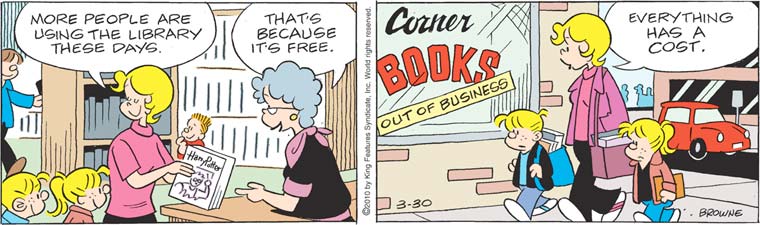
Wow, Hi & Lois, really?
Somehow this recent ladypoverty essay comes to mind, but I really couldn't tell you why.
Wow, Hi & Lois, really?
Somehow this recent ladypoverty essay comes to mind, but I really couldn't tell you why.
Monday, March 29, 2010
20-year history
Let's take it for granted that it sucks that a bunch of people just died in Moscow. Because it really, really sucks.
You know what else sucks? In a way that directly contributes to continued violence of this kind? Every single sentence in that CNN article. For example: Vladimir Putin's immediate response:
Right now I can think of no better proof of the continuity of empire than Chechnya. To my knowledge, Russia has been an imperial presence there continuously since the late 1700s. The czars, the commies, Gorbachev, Yeltsin, Putin. And Americans think switching from Bush to Obama is some kind of world-shattering change.
By the way, "Female suicide bombers blamed." Nice headline there. I'm not sure whether I'm more disturbed by the need to indicate gender in the headline or by the use of the dehumanizing "female," as if maybe suicide bombers (Explosionisis suicidensis? I don't know Latin) are some kind of newly described species. Luckily they can't produce viable offspring with humans.
You know what else sucks? In a way that directly contributes to continued violence of this kind? Every single sentence in that CNN article. For example: Vladimir Putin's immediate response:
We are providing Moscow metro with additional CCTV cameras. Today's events show we should not only continue this work but to make it more effective. Changes in legislation may be necessary.Or this reaction from a bystander, which is totally understandable and it's probably bad of me to want to tell this person to wake up and realize that when people are willing to blow themselves up it's not for no reason, and that the perfectly valid question they're asking of the terrorists should equally be asked of their own government:
"It's disgusting," one witness said. "I don't know who did it and what they wanted. Life is so short. How could people commit such terrible acts?"Or this link from the article, given the absurd headline "How Chechen rebels threaten Russian stability." Or the absurd notion, directly under where the article places that link, that there is only a "20-year history" of what they call "Chechen rebels' conflict with Russia." Absurd, absurd, absurd.
Right now I can think of no better proof of the continuity of empire than Chechnya. To my knowledge, Russia has been an imperial presence there continuously since the late 1700s. The czars, the commies, Gorbachev, Yeltsin, Putin. And Americans think switching from Bush to Obama is some kind of world-shattering change.
By the way, "Female suicide bombers blamed." Nice headline there. I'm not sure whether I'm more disturbed by the need to indicate gender in the headline or by the use of the dehumanizing "female," as if maybe suicide bombers (Explosionisis suicidensis? I don't know Latin) are some kind of newly described species. Luckily they can't produce viable offspring with humans.
Sunday, March 28, 2010
Authoritarian
Digby refers to a Red State post criticizing one of hers (if you suspect that I find her original post and the Red State response equally misguided and irrelevant, you get a prize!). The topic is the constitutionality of the HCR bill. At the end of her response post, Digby says this:
This constitutional question is whether the government can mandate that individuals buy a product from a private party simply because they are a citizen. If this person is a member of the Supreme Court (God help us) then perhaps he is in a position to render such a smug, tendentious final ruling that it doesn't. Otherwise, he's just as full of shit as that guy on TV the other day.Uh, in other words, all of a sudden Digby thinks that unless you're in a position of power you have no business stating your opinion? What is she talking about?
Saturday, March 27, 2010
Jean-Paul Sartre, Nausea p. 7
(cross-posted from Commonplace)
The best thing would be to write down events from day to day. Keep a diary to see clearly--let none of the nuances or small happenings escape even though they might seem to mean nothing. And above all, classify them. I must tell how I see this table, this street, the people, my packet of tobacco, since those are the things which have changed. I must determine the exact extent and nature of this change.
For instance, here is a cardboard box holding my bottle of ink. I should try to tell how I saw it before and now how I1 Well, it's a parallelopiped rectangle, it opens--that's stupid, there's nothing I can say about it. This is what I have to avoid, I must not put in strangeness where there is none. I think that is the big danger in keeping a diary: you exaggerate everything. You continually force the truth because you're always looking for something. On the other hand, it is certain that from one minute to the next--and precisely à propos of this box or any other object at all I can recapture this impression of day-before-yesterday. I must always be ready, otherwise it will slip through my fingers. I must never2 but carefully note and detail all that happens.
1 Word left out.
2 Word crossed out (possibly "force" or "forge"), another word added above, is illegible.
The best thing would be to write down events from day to day. Keep a diary to see clearly--let none of the nuances or small happenings escape even though they might seem to mean nothing. And above all, classify them. I must tell how I see this table, this street, the people, my packet of tobacco, since those are the things which have changed. I must determine the exact extent and nature of this change.
For instance, here is a cardboard box holding my bottle of ink. I should try to tell how I saw it before and now how I1 Well, it's a parallelopiped rectangle, it opens--that's stupid, there's nothing I can say about it. This is what I have to avoid, I must not put in strangeness where there is none. I think that is the big danger in keeping a diary: you exaggerate everything. You continually force the truth because you're always looking for something. On the other hand, it is certain that from one minute to the next--and precisely à propos of this box or any other object at all I can recapture this impression of day-before-yesterday. I must always be ready, otherwise it will slip through my fingers. I must never2 but carefully note and detail all that happens.
1 Word left out.
2 Word crossed out (possibly "force" or "forge"), another word added above, is illegible.
Bloggerdome
Justin:
The reason I single this sentence out to quote is that I would like to point out Justin's cleverness in using that word "reflection." Because we didn't see the "disagreement among factions"--we saw its distorted mirror image in the form of "the public option" and "death panels" and "It's a baby killer!" (possibly the most hilarious sentence ever uttered since the birth of language) and so on. The actual disagreement itself, while easy to infer if you have your eyes open, took place out of sight of the rubes.
Also, if you haven't seen it (I had missed it somehow) check out the comment thread at IOZ that he links to for some excellent performances by a democrathusiast on one side, and Justin and the always-delightful Rachel on the other. The democrat's sputtering incoherencies in response to Rachel's mention of Gingrich are a sight to see, as is the speed with which a liberal's fundamental misogyny is brought to bear on her.
What we just witnessed with health care reform was the reflection of a disagreement among factions of the ownership class as to how to pay for the health care of workers and consumers.The rest. It deals primarily with explaining the psychology of lesser-evilism, and how this psychology breaks down when set against the real world. Very good.
The reason I single this sentence out to quote is that I would like to point out Justin's cleverness in using that word "reflection." Because we didn't see the "disagreement among factions"--we saw its distorted mirror image in the form of "the public option" and "death panels" and "It's a baby killer!" (possibly the most hilarious sentence ever uttered since the birth of language) and so on. The actual disagreement itself, while easy to infer if you have your eyes open, took place out of sight of the rubes.
Also, if you haven't seen it (I had missed it somehow) check out the comment thread at IOZ that he links to for some excellent performances by a democrathusiast on one side, and Justin and the always-delightful Rachel on the other. The democrat's sputtering incoherencies in response to Rachel's mention of Gingrich are a sight to see, as is the speed with which a liberal's fundamental misogyny is brought to bear on her.
Tuesday, March 23, 2010
Just out of curiosity
Does anyone understand why the US Census's ad campaign seems so deliberately aimed at only the demographic that's most likely to already feel positively about the census?
Monday, March 22, 2010
Opportunity
The other week I had to sit through endless training sessions about how to be sufficiently subservient to clients of the company I work for. "Empathy statements" and "vocal tone" and "to the client you are [the company]" and all that nonsense. Sometimes I suspect that by so extensively training their employees in specific ways to fake emotions they're trying to eliminate the real thing from us entirely.
Anyway, during these classes they would occasionally play us recorded interactions between people who have our jobs and the clients. Afterwards we were supposed to rate (and then discuss, which, ugh) how the "associate" did. Every time they read off the ratings choices, both my sense of elegant parallel structure and my sense of what words mean were struck to their core (my sense of dignity had long since departed). The choices were "exceeds" (as in, "the associate exceeds the client's expectations"), "meets" (as in, "the associate meets the client's expectations") and...."opportunity."
It actually took me a while to figure out what the hell "opportunity" meant. Eventually I realized that it was another word that corporate culture had redefined to suit its own twisted needs. Opportunity, in this case, means "the associate fucked up." There is opportunity to improve!
Once I realized this, I started seeing the word used that way all over the place. Bosses were saying it, stockbrokers were saying it, John G. Miller was tweeting it. And then I remembered uses like this. And I realized: when our corporate leaders refer to events like 9/11 and Katrina and other horrible life-ending disasters as "opportunities," they're not being soulless profiteers shock-doctrining their way into ever-greater personal wealth. They're recognizing exactly how awful these events really are: every bit as terrible as a call center phone conversation that doesn't go well.
SILLY UNTRUE THEORY ADDENDUM: Maybe this is why all the good liberals are so excited about the health care abomination. It's so terrible, it's an opportunity! This theory, while about as likely to be true as the one about Obama being a secret socialist with a Plan, at least has the advantage of explaining why all the liberals seem to think that this bill will lead inevitably, or at least more easily, to its exact opposite.
Anyway, during these classes they would occasionally play us recorded interactions between people who have our jobs and the clients. Afterwards we were supposed to rate (and then discuss, which, ugh) how the "associate" did. Every time they read off the ratings choices, both my sense of elegant parallel structure and my sense of what words mean were struck to their core (my sense of dignity had long since departed). The choices were "exceeds" (as in, "the associate exceeds the client's expectations"), "meets" (as in, "the associate meets the client's expectations") and...."opportunity."
It actually took me a while to figure out what the hell "opportunity" meant. Eventually I realized that it was another word that corporate culture had redefined to suit its own twisted needs. Opportunity, in this case, means "the associate fucked up." There is opportunity to improve!
Once I realized this, I started seeing the word used that way all over the place. Bosses were saying it, stockbrokers were saying it, John G. Miller was tweeting it. And then I remembered uses like this. And I realized: when our corporate leaders refer to events like 9/11 and Katrina and other horrible life-ending disasters as "opportunities," they're not being soulless profiteers shock-doctrining their way into ever-greater personal wealth. They're recognizing exactly how awful these events really are: every bit as terrible as a call center phone conversation that doesn't go well.
SILLY UNTRUE THEORY ADDENDUM: Maybe this is why all the good liberals are so excited about the health care abomination. It's so terrible, it's an opportunity! This theory, while about as likely to be true as the one about Obama being a secret socialist with a Plan, at least has the advantage of explaining why all the liberals seem to think that this bill will lead inevitably, or at least more easily, to its exact opposite.
Don't have the energy to talk about it here
I'm amazed, and relieved, that I've gone halfway through the work day without any of my coworkers bringing up the health care thing. Fingers crossed!
Sunday, March 21, 2010
Capital can flow freely
On news of the conviction of Peter Watts (for "refusing to comply" with border police by asking what the problem was; I believe he was found not guilty of assaulting their fists with his head), many privileged white people have grown outraged (I'm looking at the comments, most of which are made by upper-middle class white people though there is some diversity there), as they should, though their surprise is a bit tiresome.
One privileged white person, the sci-fi writer Charles Stross (whose novels I have never read but whose blog posts tend to be fairly well-informed), wrote this. I think it's pretty useful:
One privileged white person, the sci-fi writer Charles Stross (whose novels I have never read but whose blog posts tend to be fairly well-informed), wrote this. I think it's pretty useful:
Capital can flow freely, but labour is in shackles world-wide.I feel about Stross about the same as he seems to feel about Marx. If you keep his MOR liberal audience (and, to a lesser extent, his own MOR liberal perspective) in mind, ignore the typical caveating about Marx and his implicit faith in electoral politics and the "rule of law" and all that, if you disregard his conclusions and his prescriptions, it's a very good diagnosis of the problem.
If you don't see a very specific political subtext here (being sold to the voting masses on the back of crude xenophobia and racism), let me be more explicit: labour wants to migrate where working conditions and pay are best. Capital wants to invest for growth where working conditions and pay are worst.
By penning us (the labour) in, capital can maintain, for a while, the wage imbalances that maximize profit. (Take raw material. Process as cheaply as possible. Sell for as much as possible.) In the long term, it's unsustainable -- labour in the high-cost developed world is taking a hammering due to being uncompetitive, and wages will be forced down until it is competitive, while labour costs in the developing world are skyrocketing. It'll end when American and EU wages meet in the middle with Chinese and Indian wages ... unless American, EU, Chinese, and Indian wage-earners are forced to recalibrate their expectations against the DRC or Somalia.
Welcome to the future that globalized capitalism has bought for us (and see also the vital, pressing need for election funding reform in the USA, which is the pivot on which this whole mess revolves). I'm beginning to think that, regardless of his prescription, Karl Marx's diagnosis of the crisis of capitalism was spot on the money.
Anyway, crap like this is going to keep happening as long as we're workers first and citizens last.
Donovan, "Riki Tiki Tavi" (bridge)
(Crossposted from Commonplace)
Everybody who's read The Jungle Book knows that Riki Tiki Tavi's a mongoose who kills snakes. Well when I was a young man I was led to believe there were organizations to kill my snakes for me: i.e., the church; i.e., the government; i.e., the schools. But when I got a little older I learned I had to kill them for myself.
Riki Tiki Tavi, mongoose is gone. Riki Tiki Tavi, mongoose is gone. Won't be coming around for to kill your snakes no more my love. Riki Tiki Tavi, mongoose is gone.
Everybody who's read The Jungle Book knows that Riki Tiki Tavi's a mongoose who kills snakes. Well when I was a young man I was led to believe there were organizations to kill my snakes for me: i.e., the church; i.e., the government; i.e., the schools. But when I got a little older I learned I had to kill them for myself.
Riki Tiki Tavi, mongoose is gone. Riki Tiki Tavi, mongoose is gone. Won't be coming around for to kill your snakes no more my love. Riki Tiki Tavi, mongoose is gone.
Friday, March 19, 2010
I am SO blogging about this
BREAKING NEWS: Blogger upset about possible developments that may happen in episodes of a science fiction show that haven't aired yet!
Kenneth Johnson's original 1983 miniseries V (I haven't seen the rest of the original series) is far from perfect, but it tries in its charming way to be a thoughtful anti-fascist allegory. As allegory goes it's single-mindedly straightforward and simplistic, but that still allows Johnson to do neat little things from time to time. Like when the elderly holocaust survivor recognizes what's going on, despite the fact that the first victims here are a more amorphous group (scientists--a very clever decision, I think) than the Jews were. Or at the beginning of the show when he follows a lovely dedication ("To the heroism of the resistance fighters--past, present, and future--this work is respectfully dedicated") with a scene of the cameraman character filming footage of Salvadorian rebels fighting off government helicopters (it is never stated who bought those helicopters, but it doesn't take much thought to realize).
Like I said, it's not perfect--it aired on a major American TV network, after all--but for what it is, it's pretty admirable.
The new V, despite a surprisingly awesome performance from Morena Baccarin as the leader of the aliens, is in comparison an incoherent, turgid mess, or at least has been so far. It is impossible to interpret it in any way but as an allegorized (is that a word?) version of the popular right-wing reaction to the Obama administration. Which, you know, is boring and pointless and just reinforces this bizarre concept that Obama is some kind of a radical departure from his predecessors; whether one takes this as a positive or a negative, it's equally untrue. But there we have it; we even had an episode about the evils of universal health care, as if a) such a thing would be awful, and b) we had any chance of getting it any time soon. Where the original series was a critique of the very real threat of fascism, the new one is a critique of a cartoon version of hysterically imagined socialism--covering for the ever-encroaching fascism Johnson saw almost thirty years ago.
An additionally insulting angle on it is that the new series is intensely anti-science. Johnson deliberately positioned his scientists as oppressed heroes; unrealistic considering the actual position of science in our society, perhaps, but a nice vision nonetheless. The new series replaces the scientists with heroes from law enforcement and religious vocations, discovering in each episode another way that science is evil.
And now the show is coming back from its lengthy hiatus with a new showrunner, and I learn that it's poised to become even worse. The new showrunner has decided that "at its spine, (the show is) really about two mothers and how far they're willing to go to protect their children." I could puke.
Convenient, too, that the male lead of the show is a priest, so I can't even object with a "Why doesn't he have to be the father of all children?"
Also in the first four episodes we already have a nonsensical interspecies pregnancy story, because having babies is what women are for, regardless of the biology. Why else would there be women in the cast? And it's a good thing they thought to cast more than one!
Kenneth Johnson's original 1983 miniseries V (I haven't seen the rest of the original series) is far from perfect, but it tries in its charming way to be a thoughtful anti-fascist allegory. As allegory goes it's single-mindedly straightforward and simplistic, but that still allows Johnson to do neat little things from time to time. Like when the elderly holocaust survivor recognizes what's going on, despite the fact that the first victims here are a more amorphous group (scientists--a very clever decision, I think) than the Jews were. Or at the beginning of the show when he follows a lovely dedication ("To the heroism of the resistance fighters--past, present, and future--this work is respectfully dedicated") with a scene of the cameraman character filming footage of Salvadorian rebels fighting off government helicopters (it is never stated who bought those helicopters, but it doesn't take much thought to realize).
Like I said, it's not perfect--it aired on a major American TV network, after all--but for what it is, it's pretty admirable.
The new V, despite a surprisingly awesome performance from Morena Baccarin as the leader of the aliens, is in comparison an incoherent, turgid mess, or at least has been so far. It is impossible to interpret it in any way but as an allegorized (is that a word?) version of the popular right-wing reaction to the Obama administration. Which, you know, is boring and pointless and just reinforces this bizarre concept that Obama is some kind of a radical departure from his predecessors; whether one takes this as a positive or a negative, it's equally untrue. But there we have it; we even had an episode about the evils of universal health care, as if a) such a thing would be awful, and b) we had any chance of getting it any time soon. Where the original series was a critique of the very real threat of fascism, the new one is a critique of a cartoon version of hysterically imagined socialism--covering for the ever-encroaching fascism Johnson saw almost thirty years ago.
An additionally insulting angle on it is that the new series is intensely anti-science. Johnson deliberately positioned his scientists as oppressed heroes; unrealistic considering the actual position of science in our society, perhaps, but a nice vision nonetheless. The new series replaces the scientists with heroes from law enforcement and religious vocations, discovering in each episode another way that science is evil.
And now the show is coming back from its lengthy hiatus with a new showrunner, and I learn that it's poised to become even worse. The new showrunner has decided that "at its spine, (the show is) really about two mothers and how far they're willing to go to protect their children." I could puke.
To me, Anna is the mother of all Vs. ... One of the things that I wanted to make clear in my version of the show was that Anna is not evil at all: Anna is simply an animal. She's a mother and she just wants to protect her children, her species, and she doesn't have anything against humanity. She's not evil. ... We're just something that stands in the way of her children's future.The "mother of all Vs" thing I was willing to let slide, reluctantly; whatever, they're aliens, fine. I'd rather something else, but fine. She's "simply an animal," though? I mean, yes, we're all animals. We're primates, the Vs are lizards, sure. But can we please have a storyline that involves women without invoking the maternal instinct?
In [that] way, Erica's the same. ... Even though it's just Tyler, her son, I feel, metaphorically, she's the mother of all children.OK, shut up. I feel bad for Elizabeth Mitchell. She just left Lost, a show where her character, and other women, were allowed to have a few motivations unrelated to motherhood and men (though admittedly they often do have those motivations, too), and now she has to be "the mother of all children" just because she's the lead woman in her new show's cast? Sucks.
Convenient, too, that the male lead of the show is a priest, so I can't even object with a "Why doesn't he have to be the father of all children?"
Also in the first four episodes we already have a nonsensical interspecies pregnancy story, because having babies is what women are for, regardless of the biology. Why else would there be women in the cast? And it's a good thing they thought to cast more than one!
I think the pregnancy story is a really fun story and weird and twisted but also very grounded and emotional. ... And there will be multiple pregnancies. ... Val will not be the only one who's pregnant.Kill me. I can't wait for when the dramatic tension really ramps up after the scene where all of humanity walks in on Erica having sex and realizes that she's not a virgin after all but really a whore!
Thursday, March 18, 2010
Affection toward institutions
Jay Taber:
Disheartening as our absence of communal relations is in America, it does help to explain our persistent affection toward institutions, as well as our attachment to their recognition and acknowledgment in validating our self-worth--indeed, in bestowing on us the right to exist.The rest is good too.
Unhealthy as this institutionalized relationship is for us, both individually and socially, it is understandable; institutions--for better or for worse--are presently the only enduring loci of collective memories for our rootless society, disconnected from the land and lives that surround us. Until we construct more functional alternatives, institutions--despite their repeated betrayals and systematic exploitation of every aspect of our daily lives--will maintain their grasp on our lonely psyches in this perverted exchange for a sense of belonging.
Ugh
So via digby I see that Kucinich has not only given up his nominal opposition to the health care ridiculousness but also begun working hard to convince others to do the same. Obviously digby and I have different perspectives on this. I take back the nice things I said about him the other day. That'll show him!
“We have to be very careful that the potential of President Obama’s presidency not be destroyed by this debate," he says. Tell me why. And what the hell is that potential, anyway? Come on. How does this shit fool anyone?
OK, I know the answer to that. It's because all of the weight of multinational capital is behind tricking people into believing nonsense like this. But my god.
“We have to be very careful that the potential of President Obama’s presidency not be destroyed by this debate," he says. Tell me why. And what the hell is that potential, anyway? Come on. How does this shit fool anyone?
OK, I know the answer to that. It's because all of the weight of multinational capital is behind tricking people into believing nonsense like this. But my god.
Wednesday, March 17, 2010
RIP Alex Chilton
Sorry about the glitch around 1:20, otherwise I love this video. Chilton's (and the rest of the band's) behavior and facial expressions are utterly bizarre and wonderful.
QBQ! Chapter Nine: Don't Ask "When?"
In which Miller continues to drive me crazy by refusing to use parallel structure. The past three chapters were all titled after "Incorrect Questions" and now this one is a command not to ask one. Hmph. Anyway.
So I guess in recent weeks Markos Moulitsas tore into Dennis Kucinich for trying to kill the current health care legislation and, sensing a good bloodfeast, Salon's Alex Koppelman dove in (Chris Floyd points out the interesting timing of this attack). In Koppelman's awkwardly sneering post he points out that in the thirteen years Kucinich has held office, only three of his bills have passed and become law. And then he points out that these are all minor things (like changing the name of a post office) of interest only to his constituents (who, being from Ohio, are clearly not important*). He also dismisses all of the actually well-intentioned and potentially beneficial legislation Kucinich has introduced (like, oh, getting out of our fucking wars) because it hasn't passed. To me, and I'm sure to four of my five readers (four of six on days when John G. Miller googles himself), the idiocy of this is obvious. The only honorable thing to do on finding oneself in the congress of the United States is to oppose it at every turn. As Floyd puts it, "just think what a howling pig circus the United States Congress has been during Kucinich's 13-year tenure...Why would anyone with even the slightest speck of honor or decency want to be considered a major, 'savvy' contributor to such a legacy?"
So when John G. Miller says
Note also how Miller moves in the course of this paragraph from "procrastination...in your life" to "deadlines are missed" for the company. It's blatantly obvious who benefits from Miller's advice--and it's not the people he's asking to follow it.
After pausing briefly for a quip, we continue:
The structure of this paragraph is also very reminiscent of the first paragraph I quoted (so he is capable of using parallel structure!) with its skillful transition from the personal to the corporate. This one's a bit more subtle, though, because Miller uses a word that means very different things depending on whether you're talking about an individual or a corporation: "costs." We get stressed, we get overwhelmed, we lose our joy: these are personal costs. But "costly to all involved"? Between this and the other paragraph it's clear that "costly" here is very literal.
And anyway. Miller and the other enforcers of our contemporary form of capitalism work very hard to remove from our lives what I might kind of embarrassingly refer to as magic. This is something I thought about a lot this past winter, because in the winter (in my climate anyway) a prime example of it keeps presenting itself. In our society, when it snows...what do we do? Do we take it as a sign that we should slow down and appreciate that something beautiful has happened? Of course not. We don't even take the time to play in it and enjoy it. We immediately coat it in salt and chemicals to turn it into a sludgy, disgusting brown slush, and plow it to the sides of the road (without regard to whether this blocks walking routes), to enable ourselves to risk our lives by going out in it in our cars and rushing off to our jobs. Most of my coworkers react with puzzled horror when I say I like snow. You have to clean it off your car, they say, and then you have to drive in it to get to work. Yes, I say, but it's beautiful. And you can have snowball fights and build things out of it and go sledding. You can use it, in other words, for purposes entirely outside of economic utility.
Related: probably my favorite essay ever posted on Stop Me Before I Vote Again, conveniently posted while I was composing my thoughts for this post. A sample:
*FULL DISCLOSURE: I mailed a package from that post office once in probably 2003 or 2004, I think.
QBQ! Table of contents
So I guess in recent weeks Markos Moulitsas tore into Dennis Kucinich for trying to kill the current health care legislation and, sensing a good bloodfeast, Salon's Alex Koppelman dove in (Chris Floyd points out the interesting timing of this attack). In Koppelman's awkwardly sneering post he points out that in the thirteen years Kucinich has held office, only three of his bills have passed and become law. And then he points out that these are all minor things (like changing the name of a post office) of interest only to his constituents (who, being from Ohio, are clearly not important*). He also dismisses all of the actually well-intentioned and potentially beneficial legislation Kucinich has introduced (like, oh, getting out of our fucking wars) because it hasn't passed. To me, and I'm sure to four of my five readers (four of six on days when John G. Miller googles himself), the idiocy of this is obvious. The only honorable thing to do on finding oneself in the congress of the United States is to oppose it at every turn. As Floyd puts it, "just think what a howling pig circus the United States Congress has been during Kucinich's 13-year tenure...Why would anyone with even the slightest speck of honor or decency want to be considered a major, 'savvy' contributor to such a legacy?"
So when John G. Miller says
Is any procrastination going on in your life? Most people don't hesitate to admit that procrastination is a problem for them. And if it's a problem for most people, it's also a problem for most organizations. What are the consequences? Putting things off means precious time is lost. Productivity suffers. The team may not progress toward its goal. Deadlines are missed.do you understand why I have a different perspective on that? "The team may not progress towards its goal"...well, what is that goal? Is its impact more to the good or to the bad in a context outside of corporate concerns? Most likely it is more to the bad. So if we retard progress toward that goal, we are doing a concrete good.
Note also how Miller moves in the course of this paragraph from "procrastination...in your life" to "deadlines are missed" for the company. It's blatantly obvious who benefits from Miller's advice--and it's not the people he's asking to follow it.
After pausing briefly for a quip, we continue:
Procrastination also increases stress. As things pile up, we begin to feel overwhelmed, which takes the joy out of our work. Bottom line: Procrastination (sic) is costly to all involved.I hardly know where to begin with this. What takes joy out of our work, John, is our jobs. That and the very nature of employment, of working for a wage. It is a fundamentally, deliberately joyless system. Joy is its mortal enemy. It is not surprising at all that you want us to define "joy" down to "not actively loathing our lives at this moment."
The structure of this paragraph is also very reminiscent of the first paragraph I quoted (so he is capable of using parallel structure!) with its skillful transition from the personal to the corporate. This one's a bit more subtle, though, because Miller uses a word that means very different things depending on whether you're talking about an individual or a corporation: "costs." We get stressed, we get overwhelmed, we lose our joy: these are personal costs. But "costly to all involved"? Between this and the other paragraph it's clear that "costly" here is very literal.
And anyway. Miller and the other enforcers of our contemporary form of capitalism work very hard to remove from our lives what I might kind of embarrassingly refer to as magic. This is something I thought about a lot this past winter, because in the winter (in my climate anyway) a prime example of it keeps presenting itself. In our society, when it snows...what do we do? Do we take it as a sign that we should slow down and appreciate that something beautiful has happened? Of course not. We don't even take the time to play in it and enjoy it. We immediately coat it in salt and chemicals to turn it into a sludgy, disgusting brown slush, and plow it to the sides of the road (without regard to whether this blocks walking routes), to enable ourselves to risk our lives by going out in it in our cars and rushing off to our jobs. Most of my coworkers react with puzzled horror when I say I like snow. You have to clean it off your car, they say, and then you have to drive in it to get to work. Yes, I say, but it's beautiful. And you can have snowball fights and build things out of it and go sledding. You can use it, in other words, for purposes entirely outside of economic utility.
Related: probably my favorite essay ever posted on Stop Me Before I Vote Again, conveniently posted while I was composing my thoughts for this post. A sample:
Pleasure -- idle pleasure -- wasted time -- is deeply suspect; everything has to have some utility -- every investment of time or effort has to show a return. Even vacations get filed under some such rubric as "recharging the batteries", so that the striver can come back with redoubled zeal to his weary corporate climb, and more than make good the time he lost on the ski slopes.Anything that doesn't "show a return" is, to Miller and his ilk, "incorrect," unhealthy, unproductive. This is as clear a sign as we could ever hope for that it is exactly what we should be doing at every opportunity--as if we didn't know already.
*FULL DISCLOSURE: I mailed a package from that post office once in probably 2003 or 2004, I think.
QBQ! Table of contents
Tuesday, March 16, 2010
Xe Part 2
Not Blackwater.
In the first part I mentioned that the awkwardness of the xe/hir construction was a major impediment to its ability to become unmarked. This brings me to my second feeling about the word, which is that I'm not sure how I feel about efforts, like this one, to normalize "deviance."
People who fall outside of our society's norms don't have many advantages as a result of their deviations, but a major one--one that, speaking as someone with a minority sexual orientation, I fucking love--is that it gives us a leg up in recognizing those norms for what they are (i.e., societal choices rather than natural law; often, impositions by and for the benefit of power) and rejecting them. To put it simply, we're already weird--we don't have to try. And given the absolutely untenable nature of the world as it is, we have to be weird--we have to reject it. All of us.
I'm a cisgendered man, so I understand that I'm coming at this issue from a position of considerable privilege. And I certainly think that these normalizing efforts are in many ways quite noble. Transgendered people are, obviously, people. People who, like everyone else, should have the right to not be exotic if they don't want to be. Just because I feel, strongly, that the world and all of its works need to be rejected fundamentally, does not mean that I have the right to demand it of other people just because they have non-standard bodies (or whatever else non-standard someone might have). And it must be really frustrating to go through daily life not even having a pronoun that comfortably refers to you. And I am well aware that frustration is the least of transgendered people's problems as they move through this crappy society of ours.
But I know that I'm extremely grateful* for my sexuality, because that aspect of my nature has been of great help in forming my view of the world. And for much the same reason that I'm ambivalent about gay marriage (it is of course ridiculous to have legal advantages available to some of the population but not all, but I'm not eager to hitch my sexual wagon to old-timey heterosexual patriarchal property transference procedures, you know?), I'm ambivalent about xe.
*Insofar as I can be grateful of something that no one gave me.
In the first part I mentioned that the awkwardness of the xe/hir construction was a major impediment to its ability to become unmarked. This brings me to my second feeling about the word, which is that I'm not sure how I feel about efforts, like this one, to normalize "deviance."
People who fall outside of our society's norms don't have many advantages as a result of their deviations, but a major one--one that, speaking as someone with a minority sexual orientation, I fucking love--is that it gives us a leg up in recognizing those norms for what they are (i.e., societal choices rather than natural law; often, impositions by and for the benefit of power) and rejecting them. To put it simply, we're already weird--we don't have to try. And given the absolutely untenable nature of the world as it is, we have to be weird--we have to reject it. All of us.
I'm a cisgendered man, so I understand that I'm coming at this issue from a position of considerable privilege. And I certainly think that these normalizing efforts are in many ways quite noble. Transgendered people are, obviously, people. People who, like everyone else, should have the right to not be exotic if they don't want to be. Just because I feel, strongly, that the world and all of its works need to be rejected fundamentally, does not mean that I have the right to demand it of other people just because they have non-standard bodies (or whatever else non-standard someone might have). And it must be really frustrating to go through daily life not even having a pronoun that comfortably refers to you. And I am well aware that frustration is the least of transgendered people's problems as they move through this crappy society of ours.
But I know that I'm extremely grateful* for my sexuality, because that aspect of my nature has been of great help in forming my view of the world. And for much the same reason that I'm ambivalent about gay marriage (it is of course ridiculous to have legal advantages available to some of the population but not all, but I'm not eager to hitch my sexual wagon to old-timey heterosexual patriarchal property transference procedures, you know?), I'm ambivalent about xe.
*Insofar as I can be grateful of something that no one gave me.
Monday, March 15, 2010
Xe
Not Blackwater.
Xe is, as far as I can tell, currently the most popular constructed genderless third person human pronoun in English (constructed to serve a purpose not adequately covered by it, which only applies to humans in a pejorative sense, and the singular they, which is a natural development of the language of ancient vintage, but which is pretty much only usable when the individual person being referred to is non-specific, rather than in cases of a specific person whose gender is not being specified). The pronoun is used primarily in cases where a person's gender is unknown (to replace the sexist practice of defaulting to "he") or when the person's gender falls outside of the traditional binary.
I have two kind of opposing, kind of complementary, feelings about the word.
The first is that as a construction it's incredibly awkward. "Xe" does not look like an English word, and there is no obvious way to pronounce it (I imagine that most people on seeing it for the first time would eventually come to the correct pronunciation, "zee," but only after some puzzling, and there's still a bunch of room for error). The object form of the word, "hir," isn't much better, particularly since on analogy from "sir" and "fir" most people would likely come to a pronunciation identical to to "her," which of course entirely defeats the purpose. If the intention is to eventually create an unmarked pronoun, so that people of indeterminate or non-traditional gender can be referred to as casually as people of specified, standard gender, then these are huge obstacles. It is true that familiarity can render anything unmarked; no one stumbles over Xerox, for example, though it shares many of the same problems. The difference, of course, is that a brand name has millions of dollars behind it working to shove it into our faces at all times; transgender people and default-he-avoiding linguistic feminists don't have this enforced familiarity working for them. In fact, both uses of the word are efforts to familiarize and normalize simultaneously (I think it's safe to say that most people don't have everyday experience with genderqueer people--to their knowledge, at any rate--or with considering the impacts of gendered language on thought). This is a difficult enough task without using such strange words. I haven't even gotten into how the particularly combination of phonemes in xe and hir make them both slightly more difficult (time and effort consuming) to pronounce than the already existent third-person pronouns, which I suspect might be an even larger obstacle.
And no, I don't have a suggestion for a better pronoun. Of what I've seen suggested, the Spivak system seems the most natural, although even it looks awfully weird written down, and no one seems to use it anyway. The naturally occurring yo found in some Baltimore schools seems promising, though I haven't heard any news about it since 2007.
My second feeling about xe is more of an emotional reaction than a procedural one. I'll be writing about it soon, hopefully tomorrow.
Incidentally, my Firefox spellchecker doesn't know the words xe, hir, genderqueer, or even transgender. Long way to go. Then again, it doesn't know how to spell Rhode Island, either, so I guess that really doesn't mean much.
And no, I don't have a suggestion for a better pronoun. Of what I've seen suggested, the Spivak system seems the most natural, although even it looks awfully weird written down, and no one seems to use it anyway. The naturally occurring yo found in some Baltimore schools seems promising, though I haven't heard any news about it since 2007.
My second feeling about xe is more of an emotional reaction than a procedural one. I'll be writing about it soon, hopefully tomorrow.
Incidentally, my Firefox spellchecker doesn't know the words xe, hir, genderqueer, or even transgender. Long way to go. Then again, it doesn't know how to spell Rhode Island, either, so I guess that really doesn't mean much.
Bjork asks the Question Behind the Question
I can decide what I giveOf course, Björk is encouraging us (and herself) to see the beauty in chaos, to welcome it into our lives and be delighted by where it takes us. John G. Miller, on the other hand, is the voice of Power and therefore of order and rigidity; in his ideal world, everything that is out of our control is in the control of our superiors, and we have no option but to acquiesce to it. Beauty, of course, is right out.
But it's not up to me what I get given
Unthinkable surprises
About to happen
But what they are
It's not up to you
Well it never really was
It's not up to you
Oh it never really was
-Björk, "It's Not Up to You"
I promise that there will be further QBQ posting soon. I know I've said this before. Chapter Nine is about procrastination, and by procrastinating this long in writing it I'm trying to appease John G. Miller, to make him think he's right. Then I'll show him!!!
Sunday, March 14, 2010
Never-ending comedy hits
Makes sense:
The article goes on to talk about what a great man Ulysses S. Grant was. Something to do with being born to "humble circumstances" and "swift and forceful action to restore order and legitimate government" and I'm sure Blacks everywhere should be happy just to shine his shoes, because even though "not himself an abolitionist, he recognized from the very start that the Civil War would cause, as he wrote, 'the doom of slavery.'" So really the jokes come fast and furious. Try not to laugh too hard because you might miss some.
Ronald Reagan deserves posterity’s honor, and so it makes sense that the capital’s airport and a major building there are named for him.Ronald Reagan fired all of the air traffic controllers for striking, and so it makes sense that the capital's airport is named after him as a reminder to stay the fuck in line.
The article goes on to talk about what a great man Ulysses S. Grant was. Something to do with being born to "humble circumstances" and "swift and forceful action to restore order and legitimate government" and I'm sure Blacks everywhere should be happy just to shine his shoes, because even though "not himself an abolitionist, he recognized from the very start that the Civil War would cause, as he wrote, 'the doom of slavery.'" So really the jokes come fast and furious. Try not to laugh too hard because you might miss some.
First impression of I'm New Here
I'm listening to Gil Scott-Heron's new album, I'm New Here, and it's really blowing me away. My first, facile, thought about it is that it sounds like a Black William S. Burroughs doing Scott Walker's The Drift, but that sells it short by making it sound derivative (not to mention that it's calling it a Black version of white things, which is goddamn crappy of me). Scott-Heron sounds really old now, in the way that the older Burroughs or Walker or Johnny Cash sound old--sometimes to the point of sounding apocalyptic.
It's also a startlingly short album; under half an hour, it feels far shorter--it just ended as I'm writing. And this is short in the good way--it gets in, does what it does, and leaves.
Incredible music, and this is all without responding at all yet to his words. Words take a lot longer to sink in for me than sounds, and I may return to this album later to write about them, and if I do I will hopefully have something more useful to say about the music as well. In the meantime: highly, highly recommended.
It's also a startlingly short album; under half an hour, it feels far shorter--it just ended as I'm writing. And this is short in the good way--it gets in, does what it does, and leaves.
Incredible music, and this is all without responding at all yet to his words. Words take a lot longer to sink in for me than sounds, and I may return to this album later to write about them, and if I do I will hopefully have something more useful to say about the music as well. In the meantime: highly, highly recommended.
Saturday, March 13, 2010
Thursday, March 11, 2010
Classy comedy
Guantanamo detainees now enjoy unprecedented rights far beyond those afforded to lawful prisoners of war with full Geneva protections.
Seems unlikely to me that Guantanamo detainees enjoy much of anything, really, but it's still a great joke.
I've got two posts in the works, incidentally, so hopefully my semi-silence will be ending soon. I'm still adjusting to newly-exhausting work requirements.
Monday, March 8, 2010
two systems
bakunin once said that he preferred a republic to a monarchy because "there are at least brief periods when the people, while continuously exploited, is not oppressed, in the monarchies, oppression is contant." i am unsure i can agree with this statement, because exploitation through illusion is a continuous mechanism within a republic. the illusion of power is a slight of hand that can produce cover, through complacency, for injustices of varying magnitudes. this isn't to say that authoritarianism is transparent. it just seems to prefer a different type of exhibitionism.
In which I pretend that the Oscars are actually relevant to anything
Kathryn Bigelow just won the Best Director Oscar for The Hurt Locker, making her the first woman ever to do so. I hate Kathryn Bigelow: Strange Days is one of the worst movies I've ever seen, and Near Dark ain't much better. I haven't seen The Hurt Locker, but it seems to be one of those Platoon-style "makes you feel what it's like to be there" war movies that are so good at making Americans feel better about their imperial adventures by feeling guilty about them, so, yeah, no thanks.
Looking at the credits, I see that there is one high-billed woman in the movie, Evangeline Lilly, who is quite famous indeed but who is still only billed seventh, after six men. Other than her, the women in the movie are Nibras Quassem, who is credited empoweringly as "Nabil's Wife", and Kate Mines, who is actually uncredited but whom imdb lists as "Soldier." Like I said, I haven't seen the movie, but what do you want to bet it doesn't come close to passing the Bechdel test?
What a victory! I think it's safe to say that we are now living in a truly post-feminist society.
Looking at the credits, I see that there is one high-billed woman in the movie, Evangeline Lilly, who is quite famous indeed but who is still only billed seventh, after six men. Other than her, the women in the movie are Nibras Quassem, who is credited empoweringly as "Nabil's Wife", and Kate Mines, who is actually uncredited but whom imdb lists as "Soldier." Like I said, I haven't seen the movie, but what do you want to bet it doesn't come close to passing the Bechdel test?
What a victory! I think it's safe to say that we are now living in a truly post-feminist society.
Sunday, March 7, 2010
Marxist feminist blug blug
I know at least 90% of the people who read this site came here through ladypoverty in the first place, but just in case someone sees this who wouldn't have looked over there, JR has written two goddamn brilliant pieces on the intersection of commodities and gender* and you pretty much have to read them. Part one and part two.
*If that sounds daunting, note that they're named after a Kelis lyric.
*If that sounds daunting, note that they're named after a Kelis lyric.
Saturday, March 6, 2010
Corporations are weird
I just went to the The Weather Channel's website to see if tomorrow's supposed to be as nice as today (it is!), and noticed that in the field where you enter your location it says "Enter ZIP, City or Place (e.g. Disney World)". It occurred to me to see who owned The Weather Channel, figuring that the Disney World mention was because it was an ABC channel, but no: NBC owns it. I'm now guessing it's a paid advertisement.
Anyway, then on the wikipedia entry for NBC Universal, it says that it's 80% owned by GE, which I knew, and that it formed in a merger between NBC and Vivendi Universal, which I also knew. But I don't know much about Vivendi Universal, so I clicked on their entry.
Where I discovered that they've existed since 1853, but only got into media mogul-ship in the late 1970s and early 80s. Before that, they were a water company called Compagnie Général des Eaux, founded by an imperial decree of Napoleon III.
And now GE owns them and they make French TV and own the Universal Music Group.
I don't know, stuff is weird sometimes.
Anyway, then on the wikipedia entry for NBC Universal, it says that it's 80% owned by GE, which I knew, and that it formed in a merger between NBC and Vivendi Universal, which I also knew. But I don't know much about Vivendi Universal, so I clicked on their entry.
Where I discovered that they've existed since 1853, but only got into media mogul-ship in the late 1970s and early 80s. Before that, they were a water company called Compagnie Général des Eaux, founded by an imperial decree of Napoleon III.
And now GE owns them and they make French TV and own the Universal Music Group.
I don't know, stuff is weird sometimes.
Friday, March 5, 2010

Thursday, March 4, 2010
Why I don't like snapshots of the zeitgeist
They're almost always stupid.
That's an essay guest-posted at the increasingly useless io9 by Bob Goodman, one of the writers of Warehouse 13, aSci-Fi ChannelSyfy show I have never watched and don't plan on watching because it sounds unbearable to me. In it he describes what he thinks the show is about. It's interesting from a writers' standpoint; as an embarrassingly infrequent writer myself, I recognize the feeling of realizing what your work is about well into the process, and also of not knowing if anyone else feels the same way about it.
As a description of the world (which it also tries to be), it's, as I hinted at above, really stupid. Here's the most ridiculous passage:
As fantasy, unrelated to the real world and what actually happens in it, we can argue about the literary merits of Goodman's description of 9/11. In the real world, trying to respond to it just gives me a headache. Hey, Bob: "the Crusades" were an endless series of wars of aggression against the various Muslim nations of the middle east and guess what that's still happening. And the way we "fight them"? More by slaughtering millions of completely unrelated people than by "cutting off the opium trade." And that's just a start. I'm too tired to go any further.
All of the nonsense about the internet as a fundamental game-changer rather than a delightful convenience, well, I'm way too tired.
UPDATE: Yeah, I was definitely too tired, because I never actually got to my point, which is in two parts.
1. Trying to reduce the motivations of the 9/11 hijackers to a kind of postmodern schizophrenic mish-mash is ridiculous; it only works if you assume that they could not possibly have had an actual motive. They weren't "still fighting the Crusades" because they just felt like it, or were too stuck in the past to move on; they were fighting it because, as I said, it's still going on. Their choice of the WTC has absolutely nothing to do with its being a 70's icon--after all, if that was the case, they wouldn't have also targeted the Pentagon (ded. 1943) and the Capitol building (built over a period from 1793 to 1811). Obviously the sites were targeted because of what goes on inside of them.
And, uh, so on.
2. Goodman's colossal misrepresentation of reality in this one teensy paragraph completely disproves his entire argument, or at least reveals that he has misunderstood it. Sure, Goodman, our lives are on shuffle. But they don't have to be. You've chosen to mindlessly believe a received narrative of 9/11 that falls apart under a moment's scrutiny. But you have the information available to you to make you realize that you've been misled, if you just chose to become aware of it. That you simultaneously are conscious that you have a wealth of information available to you and refuse to make use of it reveals quite a bit about you.
That's an essay guest-posted at the increasingly useless io9 by Bob Goodman, one of the writers of Warehouse 13, a
As a description of the world (which it also tries to be), it's, as I hinted at above, really stupid. Here's the most ridiculous passage:
I apologize in advance for invoking 9/11, but on that day at the start of the new millennium, a group of people still fighting the Crusades used airplanes to destroy a pair of iconic buildings from the 1970's, killing 3,000 people and shocking the West's financial system... and the way we fight them is by cutting off the opium trade.I think I've said before that sometimes people say things that are so completely unrelated to reality that you can't even describe them as right or wrong any more than you could use those words to describe, say, JRR Tolkien's take on Sauron.
As fantasy, unrelated to the real world and what actually happens in it, we can argue about the literary merits of Goodman's description of 9/11. In the real world, trying to respond to it just gives me a headache. Hey, Bob: "the Crusades" were an endless series of wars of aggression against the various Muslim nations of the middle east and guess what that's still happening. And the way we "fight them"? More by slaughtering millions of completely unrelated people than by "cutting off the opium trade." And that's just a start. I'm too tired to go any further.
All of the nonsense about the internet as a fundamental game-changer rather than a delightful convenience, well, I'm way too tired.
UPDATE: Yeah, I was definitely too tired, because I never actually got to my point, which is in two parts.
1. Trying to reduce the motivations of the 9/11 hijackers to a kind of postmodern schizophrenic mish-mash is ridiculous; it only works if you assume that they could not possibly have had an actual motive. They weren't "still fighting the Crusades" because they just felt like it, or were too stuck in the past to move on; they were fighting it because, as I said, it's still going on. Their choice of the WTC has absolutely nothing to do with its being a 70's icon--after all, if that was the case, they wouldn't have also targeted the Pentagon (ded. 1943) and the Capitol building (built over a period from 1793 to 1811). Obviously the sites were targeted because of what goes on inside of them.
And, uh, so on.
2. Goodman's colossal misrepresentation of reality in this one teensy paragraph completely disproves his entire argument, or at least reveals that he has misunderstood it. Sure, Goodman, our lives are on shuffle. But they don't have to be. You've chosen to mindlessly believe a received narrative of 9/11 that falls apart under a moment's scrutiny. But you have the information available to you to make you realize that you've been misled, if you just chose to become aware of it. That you simultaneously are conscious that you have a wealth of information available to you and refuse to make use of it reveals quite a bit about you.
Michel Houellebecq, The Elementary Particles p. 29
(cross-posted from Commonplace)
He was less interested in television. Every week, however, his heart in his mouth, he watched The Animal Kingdom. Graceful animals like gazelles and antelopes spent their days in abject terror while lions and panthers lived out their lives in listless imbecility punctuated by explosive bursts of cruelty. They slaughtered weaker animals, dismembered and devoured the sick and the old before falling back into a brutish sleep where the only activity was that of the parasites feeding on them from within. Some of these parasites were hosts to smaller parasites, which in turn were a breeding ground for viruses. Snakes moved among the trees, their fangs bared, ready to strike at bird or mammal, only to be ripped apart by hawks. The pompous, half-witted voice of Claude Darget, filled with awe and unjustifiable admiration, narrated these atrocities. Michel trembled with indignation. But as he watched, the unshakable conviction grew that nature, taken as a whole, was a repulsive cesspit. All in all, nature deserved to be wiped out in a holocaust--and man's mission on earth was probably to do just that.
He was less interested in television. Every week, however, his heart in his mouth, he watched The Animal Kingdom. Graceful animals like gazelles and antelopes spent their days in abject terror while lions and panthers lived out their lives in listless imbecility punctuated by explosive bursts of cruelty. They slaughtered weaker animals, dismembered and devoured the sick and the old before falling back into a brutish sleep where the only activity was that of the parasites feeding on them from within. Some of these parasites were hosts to smaller parasites, which in turn were a breeding ground for viruses. Snakes moved among the trees, their fangs bared, ready to strike at bird or mammal, only to be ripped apart by hawks. The pompous, half-witted voice of Claude Darget, filled with awe and unjustifiable admiration, narrated these atrocities. Michel trembled with indignation. But as he watched, the unshakable conviction grew that nature, taken as a whole, was a repulsive cesspit. All in all, nature deserved to be wiped out in a holocaust--and man's mission on earth was probably to do just that.
Wednesday, March 3, 2010
In case anyone cares, and I don't know why they would
I've started a new blog where all I'm gonna do is post quotes that interest me from books I'm reading. I'm not going to put any commentary on them, and they'll be interesting for different reasons (like, for example, I won't necessarily agree with the message). It's just a way to keep them all in one place and have them open to search engines in case anyone else finds them useful. It's here. Not much on it yet.
Tuesday, March 2, 2010
Weird
I find Johnny Weir pretty aesthetically unappealing, and I think the Olympics are a really enormous atrocity, but IOZ has a really good point and I hereby resolve that, going forward, I will admire the ridiculous little twink.
Monday, March 1, 2010
Great men
There are no great men. Just great challenges which ordinary men, out of necessity, are forced by circumstance to meet.I had an hour-long corporate indoctrination rah-rah meeting today at work. In it, we employees were treated to long, boring, pre-recorded presentations by a few of our owners on the subject of how much money we've made them over the past year, accompanied by shitty music (there was actually a mash-up of "Use Somebody" by The Kings of Leon and "It's the Same Old Song" by Four Tops, and of course liberal use of "I Gotta Feeling" by The Black Eyed Peas). These presentations were naturally accompanied by many insipid quotes like the one above.
-Admiral William Frederick Halsey Jr.
I single that quote out for this reason: of the thirty plus people attending this meeting only four, myself included, were men. All of the recorded presentations were by men. Everyone else involved was a woman.
There are no great men.
Subscribe to:
Posts (Atom)