Seriously, you have to watch this. The sound isn't essential--it's just goopy music--but it does add to the ambiance, so yes, I recommend you have it on.
In short, though, the story is that a "CSP" (which I think stands for Customer Service Professional*, but the video assumes we're so far indoctrinated that we don't need to be told) gives a talk to a supermarket's workers about "building customer loyalty," as if that means anything to them other than busier, harder work days, by yoking their individuality to the needs of their employer. Or, as she puts it, "Put your personal signature on the job. Think about something you can do for your customer that will make them feel special--a memory that will make them feel special."
Guaranteed, the majority of the people listening to her fantasized about doing her great harm, but tolerated her because they were getting paid for something other than working the floor of a supermarket. The video skips over this, though, to focus on one person whose story we're supposed to find heartwarming. You'll be astounded to discover I don't find it heartwarming.
The one person is "Johnny the bagger," a poor exploited Down syndrome teenager whose entire identity the video kindly subsumes into his job description. I don't know how much experience any of you have had with Down people, but in my experience, a quality a large majority of them share is a sort of earnest eagerness, a boundless capacity to take everyone at face value and try their best to please. So this guy hears this soulless CSP giving her bullshit talk, and he takes it entirely, tragically to heart.
He's sad at first, because he doesn't know how he can live up to the CSP's expectations. "After all," he says, "I'm only a bagger" (and I know, how fucking heartbreaking is that?). But then he comes up with an idea, which is probably something the CSP has never done in her entire blighted life. Every day, after work, he's going to look up interesting quotes, print out bunches of copies of them, and then the next day put them in every customer's bag.
My main reaction to this was "Oh god, he's been tricked into performing unpaid labor," though of course we're supposed to admire his dedication. It gets worse, though: Johnny's "thoughts of the day" become wildly popular, and the lines at his register start piling up to several times the length of the other lines, all because everybody wants these quotes.
At this point my mind spins, trying to deal with seventeen kinds of horror all at once. First, this guy, in addition to working for the company when he's off the clock, has doubled or tripled his workload while he's on the clock. Second, he's unintentionally done the same for whatever innocent bystander is working the register on his line. Third, how starved for genuine human interaction must we be in our society if something as chintzy as a printed out quote on a scrap of paper can make us come back, over and over, obsessively, for more?
I haven't even begun to touch on a lot of the horrifying aspects of this story--like the store manager getting a "lump in (his) throat" (and not for the reason you or I might) on finding out that some lonely woman has taken to coming back to the store every goddamn day for Johnny's quotes. And even though I've summarized most of the action of the video, I highly recommend you click through to see the full glory of the insipid, clip art presentation.
At my job, we have quarterly rah-rah meetings (I've described them glancingly before) at which we're presented with awkwardly recorded messages from our higher-ups about how much money we've made for the company--not ourselves--over the past three months, intercut with whatever shitty song currently in the top 40 best serves the "team building" spirit, and other "inspirational" nonsense. The other day, they played us this video.
One woman I work with cried. I had to fight back tears, too, but my reasons were entirely different.
The video comes from this company called Simple Truths. A quick glance at their book list reveals such other horrors as Laughter Is an Instant Vacation, No Glass Ceiling, Just Blue Sky, Even Eagles Need a Push, and The Richest Man in Town (if you guessed his riches aren't money, you're right!). I'm intimately familiar with the QBQ (which, yes, I still do plan to get back to eventually), but there is so goddamn much of this evil crap.
It's no fucking wonder we're all insane.
PS One of the white men who makes more money than me who "presented," if you know what I mean, at this meeting closed his presentation with a Ronald Reagan quote: "Every new day begins with possibilities. It's up to us to fill it with the things that move us toward progress and peace." Which is funny for a lot of reasons, none of which I feel the need to go into, though I will mention that I wasn't even aware that he had ever opened his mouth without saying something about welfare queens.
*Which has the usual hilarious advantage of rendering the word "professional" even more meaningless, which would be good if it weren't pushing its application in the wrong direction.
Showing posts with label qbq. Show all posts
Showing posts with label qbq. Show all posts
Saturday, November 13, 2010

Wednesday, May 12, 2010
What in the...
If anyone can explain to me what the devil John G. Miller is on about, you will win the prize of me eventually actually writing another QBQ post.
Much of my confusion stems from the fact that, to my understanding, the whole concept of the QBQ would be in opposition to the act of giving a homeless man food. He has to take personal accountability for his hunger!
Much of my confusion stems from the fact that, to my understanding, the whole concept of the QBQ would be in opposition to the act of giving a homeless man food. He has to take personal accountability for his hunger!
Wednesday, April 7, 2010

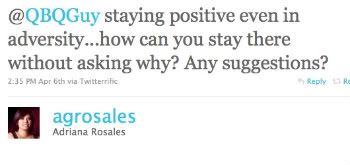
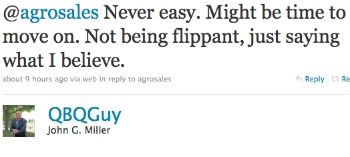
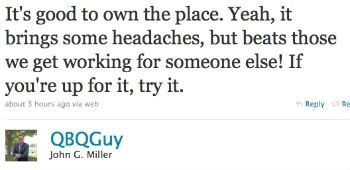
Wednesday, March 17, 2010
QBQ! Chapter Nine: Don't Ask "When?"
In which Miller continues to drive me crazy by refusing to use parallel structure. The past three chapters were all titled after "Incorrect Questions" and now this one is a command not to ask one. Hmph. Anyway.
So I guess in recent weeks Markos Moulitsas tore into Dennis Kucinich for trying to kill the current health care legislation and, sensing a good bloodfeast, Salon's Alex Koppelman dove in (Chris Floyd points out the interesting timing of this attack). In Koppelman's awkwardly sneering post he points out that in the thirteen years Kucinich has held office, only three of his bills have passed and become law. And then he points out that these are all minor things (like changing the name of a post office) of interest only to his constituents (who, being from Ohio, are clearly not important*). He also dismisses all of the actually well-intentioned and potentially beneficial legislation Kucinich has introduced (like, oh, getting out of our fucking wars) because it hasn't passed. To me, and I'm sure to four of my five readers (four of six on days when John G. Miller googles himself), the idiocy of this is obvious. The only honorable thing to do on finding oneself in the congress of the United States is to oppose it at every turn. As Floyd puts it, "just think what a howling pig circus the United States Congress has been during Kucinich's 13-year tenure...Why would anyone with even the slightest speck of honor or decency want to be considered a major, 'savvy' contributor to such a legacy?"
So when John G. Miller says
Note also how Miller moves in the course of this paragraph from "procrastination...in your life" to "deadlines are missed" for the company. It's blatantly obvious who benefits from Miller's advice--and it's not the people he's asking to follow it.
After pausing briefly for a quip, we continue:
The structure of this paragraph is also very reminiscent of the first paragraph I quoted (so he is capable of using parallel structure!) with its skillful transition from the personal to the corporate. This one's a bit more subtle, though, because Miller uses a word that means very different things depending on whether you're talking about an individual or a corporation: "costs." We get stressed, we get overwhelmed, we lose our joy: these are personal costs. But "costly to all involved"? Between this and the other paragraph it's clear that "costly" here is very literal.
And anyway. Miller and the other enforcers of our contemporary form of capitalism work very hard to remove from our lives what I might kind of embarrassingly refer to as magic. This is something I thought about a lot this past winter, because in the winter (in my climate anyway) a prime example of it keeps presenting itself. In our society, when it snows...what do we do? Do we take it as a sign that we should slow down and appreciate that something beautiful has happened? Of course not. We don't even take the time to play in it and enjoy it. We immediately coat it in salt and chemicals to turn it into a sludgy, disgusting brown slush, and plow it to the sides of the road (without regard to whether this blocks walking routes), to enable ourselves to risk our lives by going out in it in our cars and rushing off to our jobs. Most of my coworkers react with puzzled horror when I say I like snow. You have to clean it off your car, they say, and then you have to drive in it to get to work. Yes, I say, but it's beautiful. And you can have snowball fights and build things out of it and go sledding. You can use it, in other words, for purposes entirely outside of economic utility.
Related: probably my favorite essay ever posted on Stop Me Before I Vote Again, conveniently posted while I was composing my thoughts for this post. A sample:
*FULL DISCLOSURE: I mailed a package from that post office once in probably 2003 or 2004, I think.
QBQ! Table of contents
So I guess in recent weeks Markos Moulitsas tore into Dennis Kucinich for trying to kill the current health care legislation and, sensing a good bloodfeast, Salon's Alex Koppelman dove in (Chris Floyd points out the interesting timing of this attack). In Koppelman's awkwardly sneering post he points out that in the thirteen years Kucinich has held office, only three of his bills have passed and become law. And then he points out that these are all minor things (like changing the name of a post office) of interest only to his constituents (who, being from Ohio, are clearly not important*). He also dismisses all of the actually well-intentioned and potentially beneficial legislation Kucinich has introduced (like, oh, getting out of our fucking wars) because it hasn't passed. To me, and I'm sure to four of my five readers (four of six on days when John G. Miller googles himself), the idiocy of this is obvious. The only honorable thing to do on finding oneself in the congress of the United States is to oppose it at every turn. As Floyd puts it, "just think what a howling pig circus the United States Congress has been during Kucinich's 13-year tenure...Why would anyone with even the slightest speck of honor or decency want to be considered a major, 'savvy' contributor to such a legacy?"
So when John G. Miller says
Is any procrastination going on in your life? Most people don't hesitate to admit that procrastination is a problem for them. And if it's a problem for most people, it's also a problem for most organizations. What are the consequences? Putting things off means precious time is lost. Productivity suffers. The team may not progress toward its goal. Deadlines are missed.do you understand why I have a different perspective on that? "The team may not progress towards its goal"...well, what is that goal? Is its impact more to the good or to the bad in a context outside of corporate concerns? Most likely it is more to the bad. So if we retard progress toward that goal, we are doing a concrete good.
Note also how Miller moves in the course of this paragraph from "procrastination...in your life" to "deadlines are missed" for the company. It's blatantly obvious who benefits from Miller's advice--and it's not the people he's asking to follow it.
After pausing briefly for a quip, we continue:
Procrastination also increases stress. As things pile up, we begin to feel overwhelmed, which takes the joy out of our work. Bottom line: Procrastination (sic) is costly to all involved.I hardly know where to begin with this. What takes joy out of our work, John, is our jobs. That and the very nature of employment, of working for a wage. It is a fundamentally, deliberately joyless system. Joy is its mortal enemy. It is not surprising at all that you want us to define "joy" down to "not actively loathing our lives at this moment."
The structure of this paragraph is also very reminiscent of the first paragraph I quoted (so he is capable of using parallel structure!) with its skillful transition from the personal to the corporate. This one's a bit more subtle, though, because Miller uses a word that means very different things depending on whether you're talking about an individual or a corporation: "costs." We get stressed, we get overwhelmed, we lose our joy: these are personal costs. But "costly to all involved"? Between this and the other paragraph it's clear that "costly" here is very literal.
And anyway. Miller and the other enforcers of our contemporary form of capitalism work very hard to remove from our lives what I might kind of embarrassingly refer to as magic. This is something I thought about a lot this past winter, because in the winter (in my climate anyway) a prime example of it keeps presenting itself. In our society, when it snows...what do we do? Do we take it as a sign that we should slow down and appreciate that something beautiful has happened? Of course not. We don't even take the time to play in it and enjoy it. We immediately coat it in salt and chemicals to turn it into a sludgy, disgusting brown slush, and plow it to the sides of the road (without regard to whether this blocks walking routes), to enable ourselves to risk our lives by going out in it in our cars and rushing off to our jobs. Most of my coworkers react with puzzled horror when I say I like snow. You have to clean it off your car, they say, and then you have to drive in it to get to work. Yes, I say, but it's beautiful. And you can have snowball fights and build things out of it and go sledding. You can use it, in other words, for purposes entirely outside of economic utility.
Related: probably my favorite essay ever posted on Stop Me Before I Vote Again, conveniently posted while I was composing my thoughts for this post. A sample:
Pleasure -- idle pleasure -- wasted time -- is deeply suspect; everything has to have some utility -- every investment of time or effort has to show a return. Even vacations get filed under some such rubric as "recharging the batteries", so that the striver can come back with redoubled zeal to his weary corporate climb, and more than make good the time he lost on the ski slopes.Anything that doesn't "show a return" is, to Miller and his ilk, "incorrect," unhealthy, unproductive. This is as clear a sign as we could ever hope for that it is exactly what we should be doing at every opportunity--as if we didn't know already.
*FULL DISCLOSURE: I mailed a package from that post office once in probably 2003 or 2004, I think.
QBQ! Table of contents
Monday, March 15, 2010
Bjork asks the Question Behind the Question
I can decide what I giveOf course, Björk is encouraging us (and herself) to see the beauty in chaos, to welcome it into our lives and be delighted by where it takes us. John G. Miller, on the other hand, is the voice of Power and therefore of order and rigidity; in his ideal world, everything that is out of our control is in the control of our superiors, and we have no option but to acquiesce to it. Beauty, of course, is right out.
But it's not up to me what I get given
Unthinkable surprises
About to happen
But what they are
It's not up to you
Well it never really was
It's not up to you
Oh it never really was
-Björk, "It's Not Up to You"
I promise that there will be further QBQ posting soon. I know I've said this before. Chapter Nine is about procrastination, and by procrastinating this long in writing it I'm trying to appease John G. Miller, to make him think he's right. Then I'll show him!!!
Thursday, February 25, 2010
David Bohm asks the Question Behind the Question
David Bohm, Wholeness and the Implicate Order:
In scientific inquiries a crucial step is to ask the right question. Indeed, each question contains presuppositions, largely implicit. If these presuppositions are wrong or confused, then the question itself is wrong, in the sense that to try to answer it has no meaning. One has thus to inquire into the appropriateness of the question. In fact, truly original discoveries in science and in other fields have generally involved such inquiry into old questions, leading to a perception of their inappropriateness, and in this way allowing for the putting forth of new questions. To do this is often very difficult, as these presuppositions tend to be hidden deep in the structure of our thought.Where Bohm and Miller part ways, of course, is that Bohm is investigating the appropriateness of the questions we ask as a means to expanding our world view and our options, in the effort to lead us to a better understanding of the world and our place in it, and to figure out how to use this better understanding to increase harmony and happiness. Whereas Miller conducts his investigations in an effort to constrict our options to the point of vanishing, in order to increase the amount of wealth we generate for our overlords. Bohm wants us to be intellectually and spiritually curious. Miller wants us to be slaves.
Wednesday, February 17, 2010
John G. Miller has a cute dog
So that's something at least. I seem to have fallen into something of a blog-writer's block (bliter's block, or block). There should be a new QBQ up in the next few days, and hopefully I'll come up with something else to say before too long. Quick, someone send me a link to something outrageous so I can write about it. That Hilary Clinton sure is something, am I right?
I just finished watching The Prisoner, which I want to write about but have so much to say that it's overwhelming; I'd always heard that the last episode was a rushed disappointment but I was blown away by it. I'm also reading Galileo's Dream, Kim Stanley Robinson's new novel, which, silly-sounding title and concept notwithstanding, is also wonderful and highly recommended. It was a nice coincidence that I picked it up just after having read Gunn Allen's Pocahontas and being steeped in that mode of thought, along with having been introduced to Bohm's implicate order (I haven't read the book yet but will soon), because while Robinson doesn't explicitly address any of that, it forms a very powerful background to the events of the novel. I may write more about both of these works soon. Who knows.
Sunday, February 14, 2010
Friday, February 12, 2010
QBQ! Chapter Eight: "Why Don't They Communicate Better?"
This is the shortest chapter thus far. I'm going to play chicken with fair use and quote it in its entirety so we can all behold the wonder:
There's not really much to say about this, unless I'm mistaken. Miller seems to have been a bit cranky when he wrote it, but the central point is fine, I guess; if you're trying to work with someone, you have to make yourself understood to them and you have to make sure you're understanding them also. Fine, whatever. I hate to think of human communication, expression, and life reduced to this kind of utilitarianism, especially in the interest of wage slavery, and I'm tempted to bring up Hugo Ball for the second time in two days, but again: whatever.
One thing I would like to mention, though, is that it's occurring to me how ironic it is for Miller to have named his book and concept "The Question Behind the Question," because he himself seems to be completely unable to peel back even the most superficial of layers to look underneath. I gather that the workshops he mentions having facilitated are sometimes made up of managers, sometimes of low-level employees, and sometimes a mix. In each of these groups, there are very good reasons why no one will mention the real "critical issue" facing them, and will instead go for things like "communication" or "competition" or "change."
This critical issue, of course, is the system of top-down exploitation in which everyone finds themselves, at one point in the heirarchy or another. In a group of managers, no one will mention this because their continued ability to function (under the demands of both their jobs and their consciences) depends on not acknowledging this system. In a group of workers or a mixed group, of course no one will mention this because if they do they put their jobs in jeopardy (and, more immediately, they're probably thinking that the less waves they make, the faster the damn workshop will be over with). Now, not every worker will think to put it in these terms, but all of their genuine concerns, what they will really be thinking when they say communication or competition or change is the big problem--insufficient pay, shitty or no benefits, meager or no vacation and sick time, unequal pay for equal work, what have you--will always be an aspect of this larger problem.
Miller, of course, does not realize that this is what is going on--that people are lying to him--because his job depends on not realizing it.
QBQ! Table of contents
In the many workshops I've facilitated over the years, this scene has played out over and over again. I'll ask, "What's the critical issue facing your organization today?" Generally, the answer is not change or competition, but communication. Then it's framed like this: "Why don't they communicate better?"Ha ha, whee!
Actually, communication means not only being understood but also understanding the other person. The QBQ is "How can I better understand you?"
Understand?
There's not really much to say about this, unless I'm mistaken. Miller seems to have been a bit cranky when he wrote it, but the central point is fine, I guess; if you're trying to work with someone, you have to make yourself understood to them and you have to make sure you're understanding them also. Fine, whatever. I hate to think of human communication, expression, and life reduced to this kind of utilitarianism, especially in the interest of wage slavery, and I'm tempted to bring up Hugo Ball for the second time in two days, but again: whatever.
One thing I would like to mention, though, is that it's occurring to me how ironic it is for Miller to have named his book and concept "The Question Behind the Question," because he himself seems to be completely unable to peel back even the most superficial of layers to look underneath. I gather that the workshops he mentions having facilitated are sometimes made up of managers, sometimes of low-level employees, and sometimes a mix. In each of these groups, there are very good reasons why no one will mention the real "critical issue" facing them, and will instead go for things like "communication" or "competition" or "change."
This critical issue, of course, is the system of top-down exploitation in which everyone finds themselves, at one point in the heirarchy or another. In a group of managers, no one will mention this because their continued ability to function (under the demands of both their jobs and their consciences) depends on not acknowledging this system. In a group of workers or a mixed group, of course no one will mention this because if they do they put their jobs in jeopardy (and, more immediately, they're probably thinking that the less waves they make, the faster the damn workshop will be over with). Now, not every worker will think to put it in these terms, but all of their genuine concerns, what they will really be thinking when they say communication or competition or change is the big problem--insufficient pay, shitty or no benefits, meager or no vacation and sick time, unequal pay for equal work, what have you--will always be an aspect of this larger problem.
Miller, of course, does not realize that this is what is going on--that people are lying to him--because his job depends on not realizing it.
QBQ! Table of contents
Monday, February 8, 2010
QBQ! Chapter Seven: "Why Do We Have to Go Through All This Change?"
Miller, usually known for his brevity--it's hard to be long-winded when you have absolutely nothing to say--takes up three pages here with a ludicrous story about a twelve-year-old girl named Stacey (no indication of who she is or why Miller would be telling, or even would know, her story) whose father is a pilot. They're flying one day, the engine goes out, the father calmly saves the day.
Along the way we get little jewels strewn about (all of them faceted like the QBQ):
So anyway, eventually Miller delivers the moral of the story, and of course now that he's actually attempting to make a point his brevity returns:
lovechange is layoffs. His story is about going from having what you need to do what you're doing to not having it. Going from having enough people working with you to get your work done to having to do the work of several people for no more pay. Going from having a stable work environment to living in constant fear of losing your job--or actually losing it. Adapt, John G. Miller tells us from the comfort of his luxurious living room, but what he really means is fucking deal with it and settle, you low-class piece of garbage.
Incidental holy shit: I was just scanning the acknowledgments page, where I had noticed earlier there was a list of his seven children (three adopted!) and their names, to make sure that I wasn't missing some kind of weird joke where the father in the story was John G. Miller, and I just noticed that one of them is named "Jazzy." I kid you not. I pray this is a nickname, fear it isn't, and wonder if that would even make it any better anyway. For comparison, the rest of the kids have real names.
QBQ! Table of contents
Along the way we get little jewels strewn about (all of them faceted like the QBQ):
Her father understood that new challenges and changing conditions often require different strategies. Conditions change, markets change, people change. What works one day in a given situation does not necessarily work the next. We need to develop a repertoire of responses so we're prepared when our engine unexpectedly quits.So poetic. Or check out this one:
Stacey...quickly nodded her approval of Dad's plan. (This did not go off to the headquarters for a committee decision--a term that always strikes me as an oxymoron.)Miller hates discussion and participation, and longs for the rule of an Emperor-God-King. But then we knew that.
So anyway, eventually Miller delivers the moral of the story, and of course now that he's actually attempting to make a point his brevity returns:
When faced with a new situation, Stacey's dad took action and solved the problem. But if he had resisted the change and instead spent his time whining and complaining, having thoughts like "Well, I've never done it that way before!" or asking IQs such as "Why do we have to go through all this change?" things might have turned out much differently.When I first saw that one of his primary "IQs" was "Why do we have to go through all this change?" I thought it was referring to, I don't know, updating computer systems or something. But from the anecdote, and what he says about it, it's clear that what he's actually talking about when he talks about
Are you facing change? Any engines quit in your life lately? If so, ask a better question. Here's one that really works: "How can I adapt to the changing world?
Incidental holy shit: I was just scanning the acknowledgments page, where I had noticed earlier there was a list of his seven children (three adopted!) and their names, to make sure that I wasn't missing some kind of weird joke where the father in the story was John G. Miller, and I just noticed that one of them is named "Jazzy." I kid you not. I pray this is a nickname, fear it isn't, and wonder if that would even make it any better anyway. For comparison, the rest of the kids have real names.
QBQ! Table of contents
Sunday, February 7, 2010

Thursday, February 4, 2010
PSA
Tonight at 8:00 EST your friend and mine, John G. Miller, is hosting a "webinar" on Outstanding!, his recent book, which I am almost (but not quite) tempted to read. The link to register for the "webinar" (webgister) is on his blog. I'm going to be doing worthwhile things with my time (watching the season premier of LOST, which is waiting tantalizingly for me on my computer, and then probably exercising and reading about Pocahontas, if you're interested), but if you've got nothing better to do it might be hilarious (weblarious).
Wednesday, February 3, 2010
QBQ! Chapter Six: "Why Is This Happening to Me?"
The question (incorrect question! incorrect question!) that serves as the title for this chapter was introduced back in Chapter Four, wherein Miller said it was "not a very productive thought," one that makes you feel "powerless, like a victim" (and between then and now we sure learned what a terrible thing it is to be a victim!). I begged to differ.
Here's how Miller frames his in-depth, less-than-a-full-page-of-text investigation into why this question is "incorrect":
People with vast wealth and power make these things happen in their efforts to gain still vaster wealth and power for themselves. Because "the economy"? It doesn't exist. It does what it does because people decided that it does that. Sure, there may or may not be a central cabal of people consciously running things this way, but there sure are a handful of people who could just decide one day to stop.
I'd also love to see Miller have his big house in Denver with the living room bigger than a convenience store and his wife with the Sarah Palin jacket he spent several years of my income buying her and his seven children (three adopted!) and all of his speaking engagement fees and the respect from the corporate world and his appearances on Fox News programs all taken away. What kind of "decision" about stress do you think he'd make?
Now pay attention:
I'd like to point out first that Johnny G-Man does not actually explain why asking "Why is this happening to me?" leads to feeling out of control. The reason he doesn't do this is that it's impossible, because his premise makes no sense. In fact it is diametrically opposed to reality. In reality, "Why is this happening to me?" is a response to feeling--more to the point, actually being--out of control. Things happen that are beyond our control, and we ask, "Why is this happening to me?"
And as I said in my commentary on Chapter Four, this is the most empowering question we can possibly ask. So long as we don't duck the question with "everything happens for a reason" nonsense (a bit of "folk wisdom" designed to serve the ruling class every bit as much as "money can't buy happiness"), asking the question is an important step into becoming aware. And the more people who are aware, the more likelihood there is that we can work together to change things.
This, of course, is exactly why John G. Miller and the people he serves don't want us to ask the question, why they try so hard to convince us not to. As a matter of fact, Miller addresses this very truth directly, if opaquely, in the final sentence of the chapter:
QBQ! Table of contents
Here's how Miller frames his in-depth, less-than-a-full-page-of-text investigation into why this question is "incorrect":
Stress is a choice. Do you buy that? Some people have a hard time with the idea. They think it's the people and events in our lives that stress us out...but it isn't true.If you're wondering what I removed with the ellipses, it's just boring lists of interpersonal difficulties: "someone doesn't follow through," that kind of thing. I left in the portions of the list that I left in because I find it illuminating that these bad things that Miller tells us "happen" are not things that just happen. His phrasing reminds me of these plaques they have up at the rest stops on the New York Thruway: "History Happened Here!" These things aren't natural disasters or random accidents. The economy souring and jobs getting lost? That does not just "happen."
Yes, bad things happen: The (sic) economy sours, our business struggles, the stock market tumbles, jobs are lost... Life is full of these. But still, stress is a choice, because whatever the "trigger event," we always choose our own response.
People with vast wealth and power make these things happen in their efforts to gain still vaster wealth and power for themselves. Because "the economy"? It doesn't exist. It does what it does because people decided that it does that. Sure, there may or may not be a central cabal of people consciously running things this way, but there sure are a handful of people who could just decide one day to stop.
I'd also love to see Miller have his big house in Denver with the living room bigger than a convenience store and his wife with the Sarah Palin jacket he spent several years of my income buying her and his seven children (three adopted!) and all of his speaking engagement fees and the respect from the corporate world and his appearances on Fox News programs all taken away. What kind of "decision" about stress do you think he'd make?
Now pay attention:
Stress is also the result of our choices. When we choose to ask a question like "Why is this happening to me?" we feel as if we have no control. This leads us to a victim mindset, which is extremely stressful.Do you see this?
I'd like to point out first that Johnny G-Man does not actually explain why asking "Why is this happening to me?" leads to feeling out of control. The reason he doesn't do this is that it's impossible, because his premise makes no sense. In fact it is diametrically opposed to reality. In reality, "Why is this happening to me?" is a response to feeling--more to the point, actually being--out of control. Things happen that are beyond our control, and we ask, "Why is this happening to me?"
And as I said in my commentary on Chapter Four, this is the most empowering question we can possibly ask. So long as we don't duck the question with "everything happens for a reason" nonsense (a bit of "folk wisdom" designed to serve the ruling class every bit as much as "money can't buy happiness"), asking the question is an important step into becoming aware. And the more people who are aware, the more likelihood there is that we can work together to change things.
This, of course, is exactly why John G. Miller and the people he serves don't want us to ask the question, why they try so hard to convince us not to. As a matter of fact, Miller addresses this very truth directly, if opaquely, in the final sentence of the chapter:
Even in cases where we actually are victims and our feelings seem justified, "Why me?" thinking only adds to our stress.As we are told time and time again in this excrescence/excrement of a book, self-education, awareness, and efforts to retain our humanity are terrible things to be avoided at all costs, no matter how justified these actions might "seem."
QBQ! Table of contents
Thursday, January 28, 2010
QBQ! Chapter Five: The Victim
Take it away, Johnny:
Miller goes on to tell us that this "gentleman" asked all kinds of Incorrect Questions of his manager until "he went through an in-house training program on personal accountability and the QBQ," after which he
"Hating the victim" is perhaps the most pernicious pattern of thought there is. In the context of the military, it certainly explains a lot--for example, how people learn to live with themselves, not thinking of themselves as mass murderers even when they go into poor communities in poor countries and kill the shit out of defenseless poor people, in order to rain profits down on their betters. Closer to home, it explains the prevalence of rape in military communities, and the even-worse-than-usual treatment of its survivors. In a larger context, it's responsible for, among other things, the hate and fear white people have for Blacks, as well as the general sense of disdain most of us feel for anyone of lower class than ourselves. We hate those we have victimized, because otherwise our only option is to hate ourselves.
This military man, having been placed in the position of victim rather than victimizer, had two options: he could grow a sense of empathy, or he could pretend not to be a victim. He, with the QBQ as facilitator, chose the latter, because the former would have required him to question everything he had done up to that point. The latter requires only submission--something a military man is well-trained in.
The irony, of course, is that by submitting he is participating in his own victimization, whereas by learning empathy he would be taking the first steps in combating it. As Annie Hall would say, la-dee-da, la-dee-da.
QBQ! Table of Contents
I received an e-mail from a gentleman who wrote that during his ten years in the military, whenever something went wrong, the only acceptable response was "No excuses, sir!" He accepted it, he believed it, and he lived it.He also murdered people for a living, but to all right-thinking people that is supposed to be irrelevant to the point of being untrue. I would tend to think that an organization, particularly one as large as the US Military (Ha ha! I joke! There are no organizations as large as the US Military!) in which "the only acceptable response" to something going wrong is "No excuses" is one in which things are going to go wrong an awful lot, and in which nothing is ever going to be learned from this.
When he returned to civilian life, he started working as a territory manager for a large firm in the food industry. He wasn't doing as well as his company expected, and he wasn't pleased with his own performance, either.Because how in the hell could any human be pleased with their performance as "a territory manager for a large firm"? It isn't possible. Not even for bureaucratic murderers of the type the military produces. Not for anyone. I am as certain of this as I am of anything in this life (which is to say, not very certain at all, but I hope I'm right).
Miller goes on to tell us that this "gentleman" asked all kinds of Incorrect Questions of his manager until "he went through an in-house training program on personal accountability and the QBQ," after which he
closed his e-mail saying, "I realized when I learned the QBQ that from military to business, in just a few years, I had become what I hated the most: the victim."This quote could not be more perfect if I had made it up. It's entirely possible that Miller made it up, of course, but if he did so he made it up in order to agree with it, to praise it. This is the kind of insane, hate-filled drivel we're dealing with here in the guise of an inspirational text. The thing you hate the most is the victim? Good god.
"Hating the victim" is perhaps the most pernicious pattern of thought there is. In the context of the military, it certainly explains a lot--for example, how people learn to live with themselves, not thinking of themselves as mass murderers even when they go into poor communities in poor countries and kill the shit out of defenseless poor people, in order to rain profits down on their betters. Closer to home, it explains the prevalence of rape in military communities, and the even-worse-than-usual treatment of its survivors. In a larger context, it's responsible for, among other things, the hate and fear white people have for Blacks, as well as the general sense of disdain most of us feel for anyone of lower class than ourselves. We hate those we have victimized, because otherwise our only option is to hate ourselves.
This military man, having been placed in the position of victim rather than victimizer, had two options: he could grow a sense of empathy, or he could pretend not to be a victim. He, with the QBQ as facilitator, chose the latter, because the former would have required him to question everything he had done up to that point. The latter requires only submission--something a military man is well-trained in.
The irony, of course, is that by submitting he is participating in his own victimization, whereas by learning empathy he would be taking the first steps in combating it. As Annie Hall would say, la-dee-da, la-dee-da.
QBQ! Table of Contents
Friday, January 22, 2010
Holy shit!
Courtesy of ladypoverty's JRB in comments, this interview, in which John G. Miller reveals that he is personally accountable for paying fifty-seven thousand dollars* for Sarah Palin's jacket, is wonderful.
*Also known as several years of most people's lives.
*Also known as several years of most people's lives.
Thursday, January 21, 2010
QBQ! Chapter Four: Don't Ask "Why"
This is the chapter where La Miller stops merely giving advice and starts being a full-fledged activist. It's something to behold; let's watch how it happens. The chapter begins with a dramatic list, allowing for a lot of line breaks that take up a bunch of space:
Now, I will admit that many people do go wrong with the kind of thought that Miller is criticizing. When this happens, though, it is not because of the form of the thought but because of its direction: downward. The example that leaps to mind is the many working-class American whites who, casting about for someone to blame for their shitty situations, direct their frustration and rage upon working-class American Blacks and immigrants rather than against the capitalist pricks who are actually responsible. To reiterate, the problem here is not, as Miller would have it, that whites think someone besides themselves is to blame for their powerlessness; rather, the problem is that they blame those even more powerless than themselves, instead of the people who in reality have seized every ounce of power anyone else may have had and taken it for their own.
However, in the real, non-corporate fantasy world, and away from the sad delusions of understandably angry and confused white people, actions take place in a context, and that context is one of vast inequality. For people who live their entire lives on the bottom rungs of our economy, "Why is this happening to me?" is one of the most empowering questions to ask.
So, what was I talking about with that activism comment at the beginning? Johnny cleverly uses an anecdote to cover the shift:
At this point, Miller is no longer pretending to merely advise us on how to live happier lives. He is attempting to deliberately organize us into a movement, to convince us, as a group, to be complicit in our own subjugation. I, for one, refuse.
QBQ! Table of Contents
Ever heard these questions?This is clearly bullshit. John G. Miller, I can assure you, has never been powerless in his life. He has no idea what it feels like. His privilege allows him to feel perfectly comfortable lecturing us that "Questions with a 'Why me?' tone to them say, 'I'm a victim of the environment and the people around me.' Not a very productive thought, is it? But we ask them all the time." A dreadful prospect: people having unproductive thoughts all the time. Don't you people know we live to be productive? We have to produce...no, not for ourselves, our families, or our communities, don't be ridiculous. For our bosses.
"Why don't others work harder?"
"Why is this happening to me?"
"Why do they make it so difficult for me to do my job?"
Say them aloud. How do they make you feel? When I say them, I feel powerless, like a victim.
Now, I will admit that many people do go wrong with the kind of thought that Miller is criticizing. When this happens, though, it is not because of the form of the thought but because of its direction: downward. The example that leaps to mind is the many working-class American whites who, casting about for someone to blame for their shitty situations, direct their frustration and rage upon working-class American Blacks and immigrants rather than against the capitalist pricks who are actually responsible. To reiterate, the problem here is not, as Miller would have it, that whites think someone besides themselves is to blame for their powerlessness; rather, the problem is that they blame those even more powerless than themselves, instead of the people who in reality have seized every ounce of power anyone else may have had and taken it for their own.
However, in the real, non-corporate fantasy world, and away from the sad delusions of understandably angry and confused white people, actions take place in a context, and that context is one of vast inequality. For people who live their entire lives on the bottom rungs of our economy, "Why is this happening to me?" is one of the most empowering questions to ask.
So, what was I talking about with that activism comment at the beginning? Johnny cleverly uses an anecdote to cover the shift:
I was on a long flight, sitting next to a man in his mid-fifties. We introduced ourselves...[blah blah, guy's very wealthy]...he went on to say that he lives in New York City and works on Wall Street. Guess what he does? He's not a broker. He's a personal injury attorney.Yes, Jacky. Because the only reason someone you speak to would never speak to you again is because the righteousness of your profession makes them feel guilty. It has nothing to do with your being a ridiculous, aggressive asshole. Anyway, G. Miller socks us with the moral of the story, and here's where it gets deep:
When he asked me what I do [I told him I'm a speaker on the subject of] "Personal accountability," wondering if he'd see the irony--and the humor...He fidgeted a bit. Finally, just to be clear, I added, "What I really do is help people--including myself--eliminate victim thinking from their lives." He must have understood me because he got up and moved and we never spoke again!
I have nothing against him or his profession. He's simply providing what's demanded by a culture that continually asks, "Why is this happening to me?" But even as we shake our heads about the ills of society, let's not forget that society is made up of individuals. You and me. The best thing we can do to get rid of victim thinking in our world is to get rid of it in ourselves.Slow down, buddy. There is no "you and me," at least not when the "you" is you. Who the fuck is this "we" you're talking about? Now, I'm not going to get too deep into the realities of individual personal injury lawyers, particularly not those who become fabulously wealthy off of it, because it's clear that what Miller wants us to "shake our heads" about is the concept of protecting individuals from being harmed by capitalist exploitation. He wants us to shake our heads and think, "Gee, if a corporation makes my life unsafe, if a corporation hurts me because it's cheaper to them than not hurting me, trying to do anything about it will make me powerless. My best course of action is to deny the fact that I have been victimized, and look to see what action I can take to make my life better conform to the restraints placed upon it by the ruling class."
At this point, Miller is no longer pretending to merely advise us on how to live happier lives. He is attempting to deliberately organize us into a movement, to convince us, as a group, to be complicit in our own subjugation. I, for one, refuse.
QBQ! Table of Contents
Monday, January 18, 2010
QBQ! Chapter Three: QBQ! The Question Behind the Question
The title chapter!
This brief chapter lays out the "method," so-called, of the QBQ itself. I'm tempted, however, to skip over that and jump right to the money quote, which is the penultimate sentence. Oh, what the hell, here I go.
I feel as though, having quoted that, I almost don't need to say anything else about the chapter or possibly the entire book. No one who could write that sentence and consider it worthy of submission for publication could possibly have anything useful to say. Still, he and a bunch of corporate types think this joker does have useful things to say, so I guess I'm duty-bound to continue pointing out, in detail, that actually he doesn't.
"For starters," Miller gives us three simple rules fordating my teenage daughter constructing these QBQs:
QBQ! Table of Contents
This brief chapter lays out the "method," so-called, of the QBQ itself. I'm tempted, however, to skip over that and jump right to the money quote, which is the penultimate sentence. Oh, what the hell, here I go.
Like a jewel, the QBQ is made up of many facets.HAHAHAHAHAHAHAHAHAHA, right?
I feel as though, having quoted that, I almost don't need to say anything else about the chapter or possibly the entire book. No one who could write that sentence and consider it worthy of submission for publication could possibly have anything useful to say. Still, he and a bunch of corporate types think this joker does have useful things to say, so I guess I'm duty-bound to continue pointing out, in detail, that actually he doesn't.

The Question Behind the Question is built on the observation that our first reactions are often negative, bringing to mind Incorrect Questions (IQs). But if in each moment of decision we can instead discipline our thoughts to look behind those initial questions and ask better ones (QBQs), the questions themselves will lead us to better results.Now, I must say, if you strip this paragraph of its context in this dehumanizing book, as well as stripping it of its absurd reliance on Corporate Capital Letters and Acronyms (CCLAs), this is not entirely a bad point. It's not a particularly meaningful point in most situations, but, sure, we can all often overreact to things in a negative way that, if we step back and look at them more rationally, we can change to a less negative reaction. Fine. Why don't I write a fucking book about it? Maybe I can use it to trick people into thinking it's their fault the world they're forced to live in and submit to sucks so goddamn hard.
"For starters," Miller gives us three simple rules for
1. Begin with "What" or "How" (not "Why," "When," or "Who").Ask any human being! They'll tell you that overly specific grammatical prescriptions and utterly meaningless, vague suggestions to "focus" on abstract concepts are exactly what you need to turn your life around!
2. Contain an "I" (not "they," "them," "we," or "you").
3. Focus on action.
"What can I do?" for example, follows the guidelines perfectly. It begins with "What," contains an "I," and focuses on action...Yes, and so does "What can I destroy?" or, more prosaically, "What can I complain about today?" Useless, Miller, useless. "Simple," Miller tells us. "But don't let its simplicity fool you." He then lets loose about the jewel and its facets, making us all laugh for a few hours, and then tells us that "[i]n the following chapters, we'll explore these facets and see the powerful effect asking QBQs can have on our lives." Hopefully, I will begin to explore these chapters at a rate faster than one a week. This chapter was a bit of a holding pattern, but trust me--we're in for a lot of fun.
QBQ! Table of Contents
Monday, January 11, 2010
QBQ! Chapter Two: Making Better Choices
Man, I gotta get a move on with these things.
In Chapter Two, we get more into the real style of the book as a whole. The chapter sprawls luxuriantly over pages 14, 15, and 16, with half of page 14 taken up by the chapter heading, and only five lines of text on page 16. And I don't think I've mentioned, but the font in this book is massive, the lines are double spaced, and the margins are ludicrous. The book as a whole reminds me of high school, where fiddling with all those elements to meet the page length requirement was the norm.
Even all of that tiny amount of text is nothing more than filler, because the entire contents of the chapter are contained within its title. Miller sets up a metaphor regarding "goat heads," a type of thorn he tells us one finds in Denver, which "can really ruin your day" by getting lodged in your shoes or tires. What's odd is that this isn't really a metaphor for anything, or at least not for anything meaningful.
This is analogous to the "freedom of choice" that advocates of capitalism and free markets offer us. We can make any choice we want--as long as what we're choosing between is products that other people have decided to offer us for sale. And not just that, but products we can afford. This is not a choice.
QBQ! Table of Contents
In Chapter Two, we get more into the real style of the book as a whole. The chapter sprawls luxuriantly over pages 14, 15, and 16, with half of page 14 taken up by the chapter heading, and only five lines of text on page 16. And I don't think I've mentioned, but the font in this book is massive, the lines are double spaced, and the margins are ludicrous. The book as a whole reminds me of high school, where fiddling with all those elements to meet the page length requirement was the norm.
Even all of that tiny amount of text is nothing more than filler, because the entire contents of the chapter are contained within its title. Miller sets up a metaphor regarding "goat heads," a type of thorn he tells us one finds in Denver, which "can really ruin your day" by getting lodged in your shoes or tires. What's odd is that this isn't really a metaphor for anything, or at least not for anything meaningful.
Each day, as we journey into the unexplored wilds of our personal and professional lives, we have countless choices to make. And what are we choosing? Not our next action but our next thought. Choose the wrong thought and we're off in the emotional goat heads of blame, complaining, and procrastination. But the right thoughts lead us to a richer, more fulfilling life and the feelings of pride and accomplishment that come from making productive decisions.So, OK, making the wrong choices is...thorns. Remember, though, that he's not talking about what actions we choose to take, but what thoughts we choose to think. This is significant.
Sometimes people think they have no choice. They'll say things like "I have to" or "I can't." But we always have a choice. Always. Even deciding not to choose is making a choice.See, it's significant that he's talking about thoughts and not actions because we don't have choices regarding our actions. If I choose to go to work tomorrow, I'll have about $60 or $70 that I need and won't get otherwise. If I choose not to, I won't have that money, and I risk losing my job entirely. That is not a choice. Once in work, I can choose to do what my bosses tell me to do, in which case I will maintain my employment, or I can choose not to, in which case I will lose it. That is not a choice. John G. Miller is telling me, though, that I can choose how to feel about this constriction of options--I can either oppose it, maintain my personhood, and work in my life to change the circumstances that keep me and those like me--and those worse off than me--enslaved to these optionless lives, or I can give in to it, and decide to feel that my life is "richer (and) more fulfilling" by so doing.
This is analogous to the "freedom of choice" that advocates of capitalism and free markets offer us. We can make any choice we want--as long as what we're choosing between is products that other people have decided to offer us for sale. And not just that, but products we can afford. This is not a choice.
Want to avoid the goat heads and make great things happen?(Emphasis Miller's.) In other words, if I am unsatisfied with the life offered me, it is my fault, and my only option is to accept it as is. This is not a choice.
Make better choices.
QBQ! Table of Contents
Wednesday, December 23, 2009
QBQ! Chapter One: A Picture of Personal Accountability (part two)
Part One, in case you missed it.
Before I take the polar bear plunge back in to the icy waters of John G. Miller's psychotic book, I would like to point out that in comments on the first installment the indispensable JRB pointed me in the direction of John G. Miller's Amazon page, whereupon I had to immediately change my pants. First of all, I was startled and intrigued to learn that he has a photograph of himself there without a mustache, which blew my mind. And before I had fully recovered from that, I learned that, dude, he has a blog there. OK, there are only three entries in it since the first in November of 2007, but each one is a perfect little morsel of inanity (sic, or you can put an s in there if you'd like). JRB pointed out the second blog entry (blentry) in particular, and I cannot recommend it to you highly enough. To summarize, in this blentry Mr. Miller responds to a reader writing to praise a particular bank for avoiding the risky behavior that has landed a lot of banks in trouble recently (the words "risky," "landed," and "trouble" should be interpreted as comedy on my part, so laugh damn you). A questionable sentiment to be sure, but at least well intended. So how does Mr. Miller respond? By making fun of foreclosed-on homeowners for blaming anyone but themselves. Ha ha ha! I want to listen to what this man has to say!
So here I go.
When we left off, we were about to "take a look at (our occasionally mustachioed hero's) server's thinking and the choices he made." So let's take that look. Johnny Boy summarizes the situation for us again (lunch rush, busy, customer not in his section, guy goes out of his way for some reason most likely having to do with his estimation of potential tip quantities, though Miller would never consider that because he probably doesn't even tip, the bastard). Miller gives us an exciting list of questions that he thinks "many people" would have asked in this situation:
The chapter ends with an unreadable anecdote about the author returning to the restaurant a few months later, asking for this same server by name, and learning that he's been promoted to a non-server position. The conclusions Miller draws from this are obvious (why he assumes that the server is now "on his way toward his chosen goals," emphasis mine, is less obvious), but I'm more interested in this: in the anecdote, Miller refers to the poor guy as "my own personal server." Which leads me to a very, very practical, immediate, and non-political reason why those unfortunates who work in customer service should never go out of their way for a customer: if you do it, ever, for any reason, that customer will think they have a personal relationship with you. They will always expect the same in the future, no matter what, and frequently will tell friends that they can expect it, too. These people will, almost without fail, become very angry and demanding when they don't get what they want, every time. Anyone who has worked in any service position knows this, and it is the most certain way to make an impossible work situation a thousand times worse.
QBQ! Table of Contents
Before I take the polar bear plunge back in to the icy waters of John G. Miller's psychotic book, I would like to point out that in comments on the first installment the indispensable JRB pointed me in the direction of John G. Miller's Amazon page, whereupon I had to immediately change my pants. First of all, I was startled and intrigued to learn that he has a photograph of himself there without a mustache, which blew my mind. And before I had fully recovered from that, I learned that, dude, he has a blog there. OK, there are only three entries in it since the first in November of 2007, but each one is a perfect little morsel of inanity (sic, or you can put an s in there if you'd like). JRB pointed out the second blog entry (blentry) in particular, and I cannot recommend it to you highly enough. To summarize, in this blentry Mr. Miller responds to a reader writing to praise a particular bank for avoiding the risky behavior that has landed a lot of banks in trouble recently (the words "risky," "landed," and "trouble" should be interpreted as comedy on my part, so laugh damn you). A questionable sentiment to be sure, but at least well intended. So how does Mr. Miller respond? By making fun of foreclosed-on homeowners for blaming anyone but themselves. Ha ha ha! I want to listen to what this man has to say!
So here I go.
When we left off, we were about to "take a look at (our occasionally mustachioed hero's) server's thinking and the choices he made." So let's take that look. Johnny Boy summarizes the situation for us again (lunch rush, busy, customer not in his section, guy goes out of his way for some reason most likely having to do with his estimation of potential tip quantities, though Miller would never consider that because he probably doesn't even tip, the bastard). Miller gives us an exciting list of questions that he thinks "many people" would have asked in this situation:
"Why do I have to do everything around here?"Aside from the ludicrous third one, these all strike me as reasonable questions (and even that third one has a kernel of sense in it, namely, why doesn't management allow us to have what we need to do what they demand we do). According to Miller, though,
"Who's supposed to be covering this area, anyway?"
"When is management going to provide us with more products?"
"Why are we always so short-staffed?"
"When are the customers going to learn to read the menu?"
these are lousy questions. They're negative and don't solve any problems. Throughout the rest of the book we'll refer to questions like these as Incorrect Questions, or IQs, since nothing positive or productive comes from asking them [Ethan interjecting here to point out that no dictionary reads "incorrect, adj. having no positive or productive result"]. They're also the complete opposite of personal accountability, because in each one, the implication is that someone or something else is responsible for the problem or situation.More specifically, John, they implicate our betters in the problem, which is unforgivable. We must always focus our problems, our anger, inwards or, failing that, downwards--never upwards. Luckily, JG is here to tell us how to do that. After lingering lovingly on that worst of all words, "opportunity," he begins the downward slide to the bolded sentence-fragment paragraph that has been a stylistic inevitability since first we saw the book's cover.
The moment the IQs pop into our heads, we have a choice. We can either accept them--"Yeah, when are we going to get more help around here?"--or reject them, choosing instead to ask better, more accountable questions such as "What can I do to make a difference?" and "How can I support the team?"You'll notice that he has yet to define what better means in this context. This is because if he did, no one would be able to avoid realizing that he does not mean better for you. He means better for the masters, the bosses. After all, if we're not questioning our unreasonable work environments, but rather working ourselves to death within them to "support the team," then we're not organizing, not unionizing, not working together to better our situations; rather, we're staking ourselves against one another to better their profits.
This, in a nutshell, is the essence of the QBQ:
Making better choices in the moment by asking better questions.
The chapter ends with an unreadable anecdote about the author returning to the restaurant a few months later, asking for this same server by name, and learning that he's been promoted to a non-server position. The conclusions Miller draws from this are obvious (why he assumes that the server is now "on his way toward his chosen goals," emphasis mine, is less obvious), but I'm more interested in this: in the anecdote, Miller refers to the poor guy as "my own personal server." Which leads me to a very, very practical, immediate, and non-political reason why those unfortunates who work in customer service should never go out of their way for a customer: if you do it, ever, for any reason, that customer will think they have a personal relationship with you. They will always expect the same in the future, no matter what, and frequently will tell friends that they can expect it, too. These people will, almost without fail, become very angry and demanding when they don't get what they want, every time. Anyone who has worked in any service position knows this, and it is the most certain way to make an impossible work situation a thousand times worse.
QBQ! Table of Contents
Monday, December 14, 2009
QBQ! Chapter One: A Picture of Personal Accountability (part one)
The entirely of the two opening pages of this seven-page chapter (don't worry, they get much shorter as the book progresses and John G. Miller loses just as much patience with this nonsense as we do) is wasted on inept, and not coincidentally pointless, scene-setting. "It was a beautiful day in downtown Minneapolis when..." That kind of thing. The point is, our mustachioed hero has stepped into a busy restaurant and demanded (or, as he would have it, asked, politely, "with a smile," for) a Diet Coke®; upon learning that the restaurant lives on the Pepsi side of town, he changes his request to water. Some time passes and then:
So what it boils down to is that this waiter, I can only assume in a temporary lapse of judgment, decided that this guy really needs his Diet Coke®, rather than the indistinguishable Diet Pepsi® they serve or the infinitely smarter choice of water that he ended up ordering, and so takes one of his own personal dollars and purchases him a bottle of soda from the "grocery store around the corner." "My first thought was 'Hire this man!'" John G. Miller tells us; my first thought would have been more along the lines of "why the hell would he do that," but OK.
Now we come to some hilarity. Apparently, the waiter did not go to the grocery store himself:
The next part of the chapter (I believe this is the only chapter long enough that it can be considered to have "parts") "take(s) a look at my server's thinking and the choices he made." In order not to make this post nine thousand words long (I wish I could avoid being overly wordy and digressive, but I seem to be incapable), I will cover that part of the chapter, and what I consider a more likely interpretation of the event than the one Mr. Miller presents us with, in the next installment.
QBQ! Table of Contents
Suddenly, there was a blur of activity off to my left, the "wind of enthusiasm" stirred behind me, and then, over my right shoulder stretched "the long arm of service," delivering a twenty-ounce bottle, frosty on the outside, cold on the inside, of--you guessed it--Diet Coke!First of all, let me assure you that I am not fucking kidding you about that style. That is a direct quote. Much of my objection to the style is I'm sure obvious, but I do want to explicitly point out one thing: normally the construction "____ on the outside, ____ on the inside" is used to describe contrast; if a bottle is frosty on the outside, what else would the contents be but cold? Anyway. I should get to the point, lest I waste more words than Mr. Miller himself.
So what it boils down to is that this waiter, I can only assume in a temporary lapse of judgment, decided that this guy really needs his Diet Coke®, rather than the indistinguishable Diet Pepsi® they serve or the infinitely smarter choice of water that he ended up ordering, and so takes one of his own personal dollars and purchases him a bottle of soda from the "grocery store around the corner." "My first thought was 'Hire this man!'" John G. Miller tells us; my first thought would have been more along the lines of "why the hell would he do that," but OK.
Now we come to some hilarity. Apparently, the waiter did not go to the grocery store himself:
By then I was thinking profound and professional thoughts like "Cool!" But what I said was, "Come on, you've been awfully busy. How did you have time to go get it?" Smiling and seemingly growing taller before my eyes, he said, "I didn't, sir. I sent my manager!"Given the options, Mr. Miller, I'm going with "what." If we have defined "empowerment" down to the level of asking our master to help us better prostrate ourselves before rich fuckers, then we might as well empower ourselves with nooses.
I couldn't believe it. Was that empowerment or what?
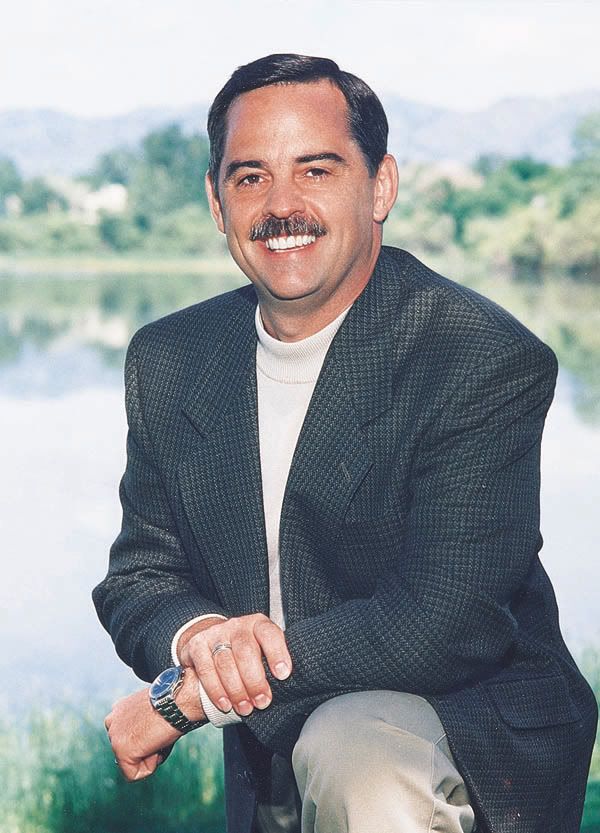
The next part of the chapter (I believe this is the only chapter long enough that it can be considered to have "parts") "take(s) a look at my server's thinking and the choices he made." In order not to make this post nine thousand words long (I wish I could avoid being overly wordy and digressive, but I seem to be incapable), I will cover that part of the chapter, and what I consider a more likely interpretation of the event than the one Mr. Miller presents us with, in the next installment.
QBQ! Table of Contents
Subscribe to:
Posts (Atom)