Friday, July 23, 2010

Lies! Lies! Breaking my heart!

Lying is of course frequently a bad, bad, naughty thing to do, and it's probably at its naughtiest when it's used as part of a PR campaign in the buildup to a war. But between the lie and the war, I'm pretty sure the lie is the less-bad thing. Now, I'm not so simple as to think that the lie and the war are discrete, separable items, unrelated in the sequence of events. They're not, any more than, oh, I don't know, the soap suds and the clean dishes are (I just did the dishes).

Actually, that terrible metaphor sidetracked my thinking onto this path: it's possible to clean dishes without the soap suds, but it's easier to do it with them, just as it's possible to go to war with or without lies, but easier to do so with them. But once the dishes are clean, once they're demonstrably, unarguably clean, there is very little point in arguing over whether or not soap suds were used in cleaning them.

Of course, the metaphor, being terrible, begins to break down here, because the discussion of whether or not "the Bush Administration" (more correctly the imperial capitalist powers) used lies as part of the buildup to the definitive 2003 escalation of war in Iraq (and if you actually attempt to argue that they didn't, then like Karl Rove you clearly have a vested interest in doing so) can at least potentially have the effect of illuminating the reality of just exactly what it is that's going on with that whole war thing.

But the unspoken, and sometimes even explicitly spoken, assumption of not only Rove's article but also the liberal/Democrat rhetoric that preceded and will follow it, is that the presence or absence of these lies actually plays a part in determining the morality of the war itself. And this is complete nonsense.

Scenario One: George W. Bush says Iraq has nuclear weapons, Colin Powell says that Iraq went to The Mall of the Africas shopping for uranium, and then American troops go into Iraq and kill several millions of people for money.

Scenario Two: George W. Bush says he and his friends will make lots of money if American troops go into Iraq and kill several millions of people, Colin Powell says that he and his friends will make lots of money if American troops go into Iraq and kill several millions of people, and then American troops go into Iraq and kill several millions of people for money.

In which scenario do more people die?

Again: I am not saying that a discussion of the nature of the lies is a bad thing. But in all that discussion, the fact that millions of people have died seems to get lost. War is an evil thing regardless of the excuses people give for it, regardless of why people say they do it, regardless of whether or not people lie about it. The lie, in and of itself, is not the Big Bad here.

On a different note, this paragraph in Rove's article interested me:
The battering would continue, and it was a monument to hypocrisy and cynicism. All these Democrats had said, like Mr. Bush did, that Saddam Hussein possessed WMD. Of the 110 House and Senate Democrats who voted in October 2002 to authorize the use of force against his regime, 67 said in congressional debate that Saddam had these weapons. This didn't keep Democrats from later alleging something they knew was false—that the president had lied America into war.
Mostly because it's a very odd sensation to read the first three sentences of a paragraph, and the first nine or ten words of the last sentence, and think "This guy's right on the money," and then read the rest of the last sentence and think "What the fuck is this insanity?"


All is well in the world

If the question is, do we really need a stage musical version of Animal Farm, the answer is of course "Yes, yes, yes!"

The question then becomes, of course, who, of all of the world's brightest musical talents, is best suited to shepherd this urgently-needed adaption from its current "beautiful dream" stage to its final, completed perfection?

The answer to this question is as obvious as the answer to the first question: why, Elton John, of course!

Derrick Jensen, Endgame vol. 1: The Problem of Civilization, pages 284-285

(Cross-posted from Commonplace)

The checkout guy hates his job. Or at least he would if he allowed himself to feel in his body the slipping away of his own precious lifetime. Perhaps, though, it's more accurate to say "his own no-longer-precious lifetime," since if it were really precious he would not--could not--sell it so cheaply, nor even sell it for money at all. But he has been trained never to think of that, and especially to never feel it. If he thought of that--if he felt himself spending the majority of his life doing things he did not want to do--how would he then act? Who would he then be? What would he then do? How would he survive in this awful, unsurvivable system we call civilization? How, too, would we all respond if we fully awoke to the effects of the drip, drip, drip of hour after hour, day after day, year after year sold to jobs we do not love (jobs that are probably destroying our landbase to boot), and how would we respond, too, if we paid attention to the effects of other incessant drippings such as airbrushed photo after airbrushed photo on something so intimate as what--not whom, never whom--we find attractive?

...

A high school student bags the groceries. She's been through the mill. Twelve years of it, not counting her home life, twelve years of sitting in rows wishing she were somewhere else, wishing she were free, wishing it was later in the day, later in the year, later in her life when at long last her time--her life--would be her own. Moment after moment she wishes this. She wishes it day after day, year after year, until--and this was the point all along--she ceases anymore to wish at all (except to wish her body looked like those in the magazines, and to wish she had more money to buy things she hopes will for at least that one sparkling moment of purchase take away the ache she never lets herself feel), until she has become subservient, docile, domestic. Until her will--what's that?--has been broken. Until rebellion against the system comes to consist of yet more purchasing--don't you love those ads conflating alcohol consumption (purchased, of course, from major corporations) and rebelliousness?--or of nothing at all, until rebellion, like will, simply ceases to exist. Until the last vestiges of the wildness and freedom that are her birthright--as they are the birthright of every animal, plant, rock, river, piece of ground, breath of wind--have been worn or torn away.

Free will at this point becomes almost meaningless, because by now victims participate of their own free will--having long since lost touch with what free will might be. Indeed, they can be said to no longer have any meaningful will at all. Their will has been broken. Of course. That's the point. Now, they are workers. They are productive members of this great and benevolent structure of civilization that brings good to all it touches. They are happy, even if this happiness requires routine chemical assistance. There is no longer any need for force, because the people--or more precisely those who were once people--have been fully metabolized into the system, have become self-regulating, self-policing.

Welcome to the end of the world.

Wednesday, July 21, 2010

It is possible for me to have more objections to a paragraph than there are words in it

For example:
America is a Utopian society. It aspires to an achievable perfection, a middle-class egalitarian meritocratic democracy with no kings, no pharoahs, no rulers by inheritance or divine right. In this it is different to Britain, where I grew up, which has class differences that in many ways no side really wants to erase, rather only to throw the other down, or keep them down.

The thing...

...about going on strike (oops, sorry, I mean on STRIKE), as a blogger, is that you should stop blogging.

Monday, July 19, 2010

Moratorium

If I never, ever see anyone on the internet

1. Referring to formal logical fallacies by name,
2. Referring to Godwin's Law, or
3. Acting like either of these things mean that they "win" an argument,

ever again, I will be extremely happy. I mean seriously. If it is possible for conversation to get stupider, I don't know how.

I think "strawman" is my least favorite, mostly because the bulk of the times that I see people invoking it, all it means is that they're too dense to understand what the other person is saying, typically because they don't know how to see the world outside of their own tiny little sphere of understanding.

(Inspired by looking over still more comment threads at Pharyngula.)

Sunday, July 18, 2010

Derrick Jensen, Endgame vol. 1: The Problem of Civilization, page 84

(Cross-posted from Commonplace)

I need to say that I no more advocate violence than I advocate nonviolence. Further, I think that when our lifestyle is predicated on the violent theft of resources, to advocate nonviolence without advocating the immediate dismantling of the entire system is not, in fact, to advocate nonviolence at all, but to tacitly countenance the violence...on which the system is based.

Friday, July 16, 2010

Knowing when to stop talking

This is a weirdly lucid thing for a celebrity wife to say, and particularly weird as a preamble to an extended meditation on how prostitutes are asking to be raped, so it's OK to do it:
I cannot explain why men do what they do. I don't understand why we're destroying the Earth to get to Jupiter. That doesn't make sense to me. I don't understand why we're fighting a war, spending billions of dollars fighting a war over oil, instead of spending that money on stuff that we don't need oil. I don't understand why men do what they do.
If she had just left off there, she would be my new favorite person. Unfortunately, she then goes on to defend her rich football player husband's right to rape prostitutes, so, you know, scratch that.

On religion and goat fucking

And now, commentary on the Pharyngula post that led to chaos, destruction, and the near dissolution of my blugfriendship with BDR.

Here's PZ Myers' latest imbecility. (Just kidding! He posted it two mornings ago, so there have been plenty of imbecilities since.) Take a look at it. See the problem? Apparently, PZ thinks the only significant difference between Pakistan and, say, the United States that might have an impact on online behavior is....religion. Is that so.

Take a look at this list. I'm not 100% clear on how Wikipedia defines "internet user," but regardless it seems like a good starting point. We see that 10.6% of the Pakistani population is online. In the US, it's 76.3%. There is one factor in any country that will consistently separate internet users from non-internet users, and it's not religion. I'll leave it to you to figure out what I might be talking about.

And that is of course just the beginning. When you're talking about Pakistan, for fucking hell's sake, you can't disregard its, uh, relationship with the US. Now I don't have statistics handy, but it's a good bet that those members of the Pakistani population who have internet access are more likely to have US ties, while the primary interaction between the US and those who do not have internet access is more likely mediated by predator drones.

And another thing: PZ's argument seems to be that the more repressive a person or a society is about expressions of sexuality, the more interested individuals are going to be in it in private, and that this means everyone should be open about sexuality. And while I have no particular opinion on this line of reasoning in specific, I'm certainly in favor of sexual openness, no fan of sexual repression. However, it is an easily observable fact that PZ Myers himself is not in favor of open expressions of the kind of sexuality directly relevant to the post, which are in fact bestiality and pedophilia. I'm always open to a discussion about these things, and I think their morality or lack thereof is far from a settled question, but Myers is definitively of a different persuasion. So what, exactly, is his point here?

And finally. There is an argument similar in structure to PZ's "the more someone says they're against sex, the more they're into it in private" that I do think is pretty consistently valid, and that's this: "the more someone says they're committed to rational evaluation of the world based on empirical evidence, like, oh, say, capital-A Atheists, the more they are absolutely idiotic, smugly ignorant, and completely unaware of their massive, massive blind spots." This post and its lengthy comment thread are excellent examples. About the first half of the thread is taken up by discussion about whether the methods used to attain and analyze the data are valid, but with no mention of the fact that the data sets for different countries with different types of social and economic stratification are not directly comparable and that therefore the entire premise of the whole discussion is nonsense. Then, a commenter using the name "Pakistan" comes in to berate the commenters and the original post for their racism, which, yes, absolutely. It's only part of the problem with the whole thing, but in any Pharyngula discussion there are going to be so many things to object to that it would be impossible to cover them all. (And I love his response when people point out that the only person who has used the phrase "sand nigger" is him: "I apologize profusely for suggesting that any of the good people of Pharyngula would say something ignorant and potentially racist straight out." Accurate!) Then the rest of the thread mostly consists of people haughtily pointing out that it's simply impossible that they might be engaging in racism (none of them, incidentally, aware of the distinction between "being racist" and "being a racist"). I leave you with this comment, which might be one of the most breathtakingly ignorant and awful things I've read in a good long while. She says that Pakistan
as a whole IS a fundamentalist hellhole though, largely due to Islam and ignorance. The Taliban seem to be ramping up, the government is a corrupt US puppet, and no one seems to care.
To paraphrase someone or other, what do you mean "no one," paleface?

Thursday, July 15, 2010

Chumbawamba, "The Candidates Find Common Ground" (from Never Mind the Ballots, 1987)

(cross-posted from Commonplace)

A: Full employment, slave labor, and schemes
B: An unemployed workforce, the capitalist's dream
A & B: But let's keep Britain working
   Either way we must keep Britain working
A: Conventional weapons to kill people nicely
B: Nuclear weapons to keep the peace
A & B: But weapons definitely
   Either way we must defend ourselves
A: Nationalization, with one big boss
B: No, privatization, with lots of little bosses
A & B: But someone in control, of course
   Either way there must be someone giving orders

chorus:
A toast to democracy
The prison guard of this society
Sides in the voting game
Disappear into the same machine

A toast
To US bases and nuclear weapons
To stopping pickets, pulling down fences
To the British troops in Northern Ireland
To the wonderful victory in the Falklands
To the plastic bullet and the riot police
To the UDM, to the TUC
To isolating gays and to law and to order
To richer bosses, to poorer workers

chorus

A toast
To longer hours and to less pay
To the courts for those who get in our way
To the beating of the people who step out of line
To the use of troops to break a strike
To the expulsion of extremists and to political witch hunts
To repatriation, to benefit cuts
To peaceful settlements, and to no strike agreements
To authority, to power, to governments

To the annual rise in the MP's wage
To vested interests, to privilege
To the party who wins the next election
By definition a victory to capitalism

Wednesday, July 14, 2010

Being alive

I was just riding the bus home from work, struggling to read. I say struggling because I kept getting distracted by the noisy conversation the bus driver and a few of the people sitting near the front were having. And when I say "noisy," I mean noisy.

The conversation was wide-ranging. I first started picking up on it when they were talking about the various ways you can get electrocuted during a thunderstorm (we had thunderstorms here today), and the different things you can do to increase or decrease your chances of it. Then, via an anecdote about someone being electrocuted as a result of peeing on a third rail, they seamlessly transitioned to talking about the Acela and in general the viability of Amtrack as an enterprise. I got back to reading again, but then got distracted by some disdainful talk about celebrities who have recently bought property in Rhode Island (Nicholas Cage, Arnold Schwarzenegger on behalf of his granddaughter) and the possibility of turning the Westin Hotel and the Providence Place Mall, to which it is connected by a covered walking bridge, into a sort of refuge-living-space-casino complex for the very wealthy, which idea was met by much hostility (as far as I know, it is not likely to actually happen, and I don't think anyone's even talking about it).

And so on. As I said, I kept getting distracted from my reading, and was finding myself more and more irritated. Why don't they shut up, I thought. They seemed to be having a great time, and they were all manifestly smart and engaged and funny and lively and interested in the world around them, but: they were distracting from my reading, and it annoyed me.

The book I was reading was Derrick Jensen's Endgame, Vol. 1: The Problem of Civilization, which I have just started reading at Richard's suggestion. The passage I was so irritated at being distracted from was this one, which I have massively truncated from pages 19-20:
...if we dig beneath [the] second, smiling mask of civilization--the belief that civilization's visual or musical arts, for example, are more developed than those of noncivilized peoples--we find a mirror image of civilization's other face, that of power. For example, it wouldn't be the whole truth to say that visual and musical arts have simply grown or become more highly advanced under this system; it's more true that they have long ago succumbed to the same division of labor that characterizes this culture's economics and politics. Where among traditional indigenous people--the "uncivilized"--songs are sung by everyone...within civilization songs are written and performed by experts, those with "talent," those whose lives are devoted to the production of these arts... I'm not certain I'd characterize the conversion of human beings from participants in the ongoing creation of communal arts to more passive consumers of artistic products manufactured by distant experts...as a good thing.

I could make a similar argument about writing, but Stanley Diamond beat me to it: "Writing was one of the original mysteries of civilization, and it reduced the complexities of experience to the written word. Moreover, writing provides the ruling classes with an ideological instrument of incalculable power. The word of God becomes an invincible law, mediated by priests... symbols became explicit; they lost a certain richness. Man's word was no longer an endless exploration of reality, but a sign that could be used against him..."

[Jensen moves on to his next point, or rather to the next part of the same point]

...I'm not certain that the ability to send emails back and forth to Spain or to watch television programs beamed out of Los Angeles makes my life particularly richer. It's far more important, useful, and enriching, I think, to get to know my neighbors. I'm frequently amazed to find myself sitting in a room with my fellow human beings, all of us staring at a box watching and listening to a story concocted and enacted by people far away. I have friends who know Seinfeld's neighbors better than their own... The other night, I wrote till late, and finally turned off my computer to step outside and say goodnight to the dogs. I realized, then, that the wind was blowing hard through the tops of the redwood trees, and the trees were sighing and whispering. Branches were clashing, and in the distance I heard them cracking. Until that moment I had not realized such a symphony was taking place so near, much less had I gone out to participate in it, to feel the wind blow my hair and to feel the tossed rain hit me in the face. All of the sounds of the night had been drowned out by the monotone whine of my computer's fan... [G]iven the impulse for centralized control that motivates civilization, widening communication in this case really means reducing us from active participants in our own lives and in the lives of those around us to consumers sucking words and images from some distant sugar tit.
Once I got that far and the meaning of the words began, along with my increasing agreement with them, to sink in, I started to become ashamed of my previous irritation. I gave up trying to read, because after all I can do that any time I want*. I closed the book, and while I didn't go so far as to join in with the conversation (I'm shy), I did listen, appreciatively, and did feel part of a community, if only glancingly, and only briefly. It was nice.

Then I got home, turned on my computer, opened all the windows, and was immediately startled by the call of a bird. Not knowing at first how to interpret the sound, unfamiliar in this context, I thought for a moment that it was my computer issuing its death rattles. Baby steps; I guess I can't expect to become a fully functional life-form in an instant.

*Except of course during work hours!!!

Tuesday, July 13, 2010

If things were going well

Stated by a liberal, blithely, apparently without any need for explanation:
If things were going well in the US, unemployment would be about 5,000,000, or around 3% of the 153,741,000 people in the total US labor force
Now, I am firmly of the persuasion that no one needs jobs, that in fact we'd all be better off, individually and as a society, if no one had jobs.

However, in the United States as currently constituted, in the reality that liberals pride themselves on living in, people need what jobs get them. Jobs give people scheduled permission to acquire goods, and we need that permission even, or especially, to acquire necessary goods. But if "things were going well," according to Jacob Davies, there would still be five million people (five million Americans, the most sacred of all kinds of people) going without that scheduled permission to acquire necessities--the permission to live.

This being the internet, Davies brings zombies into it, making some kind of wretched, belabored metaphor about the unemployed being in peril along the lines of a zombie attack. However, while this seems to indicate that he recognizes the disaster that is being unemployed in our society (or at least recognizes it on some level covered over by internet-style "awesome!!" and by his continuing to talk in financial terms, which would seem to make the whole metaphor pointless), he only applies this metaphor to the unemployed population that rises above his "doing well" level. So those five million, what--they deserve it? Is that what I'm supposed to make of this? How do we pick which five million are the healthy-functioning-society unemployed population, and which are the ones under attack by zombies?

I realize that late-stage capitalism, in order to survive, requires some level of unemployment. But surely it's not capitalism but rather human beings that we're trying to help survive. Right?

PS I'm deliberately ignoring everything else in Davis's article.

Crutches for brains

When he can pull himself away from, for example, being "rather worried" by "violent action against property" (and my god, even if you are going to take that ludicrous construction seriously as something to be worried about, does spray painting a billboard even count?), PZ Myers is occasionally able to say something interesting.

The article is about the limitations of the human brain, many of which I was familiar with already. If you aren't, I don't recommend starting with this brief, snotty article; I'd say go for a book by V.S. Ramachandran or someone like him, who unlike friend Myers is genuinely, consistently interesting, and feels no need to be a dick to make up for his own inadequacies as a human being.

What I like here is this brief passage, ignoring the miserably failed attempt at goofy humor that concludes it:
We even build crutches for brains. Math is a crutch. Science is a crutch. Philosophy is a crutch. Artists, too, use learned heuristics to get their minds to operate reliably in that unnatural mode. We rely utterly on these kinds of intellectual tools to focus our brains efficiently on problem solving, rather than doing what comes naturally, which usually involves snarfing down cheeseburgers and having wild monkey sex with other bipeds.
This might make me dumb, but I had never, ever thought to frame things that way. Leaving aside the art and philosophy for the moment, I was of course aware of the essential incompleteness and blundering nature of scientific inquiry, and I've long had a layman's fascination for the mystery of how it is that math, an abstract, constructed system totally disconnected from reality, seems to be very, very good at describing the way the universe works. But it never occurred to me to think of these things as crutches, with all that implies.

Imagine, being able to see the workings of the universe we live in directly, without the assistance of math and science. To be able to just understand. It's kind of a breathtaking thought.

Sunday, July 11, 2010

There should be a place for the rack in the torturer's arsenal

I've said before that despite all of her massive, massive, highly useful-to-power blind spots, digby should at least be praised for her dedicated reporting on the horrifying use of tasers by police forces, particularly in the US but also worldwide. And yes, her dedication to documenting the atrocities is admirable.

But Jesus goddamned Christ, how the fuck do you explain this?
There should be a place for the taser in the policeman's arsenal.
No, no, no, a thousand fucking times Jesus no.

A note that will not reach anyone it needs to reach

Anyone who could write or take seriously an article titled The Unforced Errors of the Obama Administration (Escalation in Afghanistan, whoops! Full-bore endorsement of the 2008 bank bailout, whoops!) clearly needs to read, and understand, JR's Marxist review of the Obama administration over at ladypoverty.

Sad

This is extremely awful and sad and I will not approach it with the usual sarcastic disdain with which I usually approach Shakesville.

The punishment to which Sakineh Mohammadi Ashtiani was sentenced (I see there may now be a reprieve) is horrifying. And I'm not going to object to people worldwide working to call attention to it, per se; though I think that that time could be more productively spent calling attention to local atrocities (of which there is never anything approaching a shortage), I'm not in any position to judge priorities and I'm not heartless enough to tell people to mind their own business when the horrible death of a human being is involved.

However, calling upon members of the leadership of the United States of America to "to take a bold stance on behalf of the women of Iran" is exactly the wrong way to do it. Taking a bold stance of behalf of the women of Kuwait was part of our justification of the initial invasion of Iraq in 1990, and taking a bold stance on behalf of the women of Iraq was part of the justification for the massive, definitive escalation there in 2003. In the meantime, taking a bold stance on behalf of the women of Afghanistan was part of the drumbeat to war there well before 9/11, and this bold stance became even bolder in the run-up to the full-scale invasion afterward.

When I saw McEwan's letter to Hillary Clinton at the end of the post, a chill went down my back.

Bold stances on behalf of the women of the world are wonderful things, coming from people who care about humanity. Coming from our leaders, they're just another excuse for death, death, death. This is yet another reason why, if we truly want to change things in this life, appealing to power to provide us with top-down solutions is never, ever going to work.

Saturday, July 10, 2010

THIS IS THE CHINA PEOPLE AND QUEERS

I'm really glad I read blogs where certain individuals specialize in getting outraged by certain other individuals' public behavior, because otherwise I never would have learned how delightfully unhinged Gallagher, of all people, is these days. Select quotes:
On tattoos: That ink goes through to your soul—if you read your Bible, your body is a sacred temple, YOU DIPSHIT.

If Obama was really black, he'd act like a black guy and get a white wife.

On, uh, the Rice Krispie elves, for some reason?: All three of those guys are gay. Look at 'em!

This is why I'm not on TV. I am powerful. They can tell.
Sounds like he's found a niche for himself.

Thursday, July 8, 2010

Warning signs

I've just started reading Michelle Alexander's The New Jim Crow (I know I said I was going to start reading it on the 4th, but Star Trek is very distracting). And, well, I'm six pages in and already hoping it gets better.

From page 2:
I first encountered the idea of a new racial caste system more than a decade ago, when...I noticed a sign stapled to a telephone pole that screamed in large bold print: The Drug War Is the New Jim Crow. I paused for a moment and scanned the flier... I sighed, and muttered to myself something like "Yeah, the criminal justice system is racist in many ways, but it really doesn't help to make such an absurd comparison. People will just think you're crazy."
She presents this as an attitude she's moved on from, but then how to explain this, on page 6? After going through the (as she takes pains to point out) circumstantial evidence that the CIA (as she takes pains to point out) might have had something to do with the explosion of crack distribution in Black neighborhoods in the mid-80s, she talks about the drug war (as she mentions, launched before the crack thing started and during a time of declining drug use nationwide) and the resulting prison population boom:
The United States now has the highest rate of incarceration in the world, dwarfing the rates of nearly every developed country, even surpassing those in highly repressive regimes like Russia, China, and Iran.... No other country imprisons so many of its racial or ethnic minorities. The United States imprisons a larger percentage of its black population than South Africa did at the height of apartheid.
What, then, would it take for Alexander to place the United States on her mental list of "repressive regimes"? Because to me the list appears to be made up of three countries who oppose the US's economic interests and one country whose repressive regime can safely be imagined to have collapsed long ago.* In other words, the MICFiC-approved list of naughty naughty nations.

The only explanations I can come up with are either that Alexander, despite her awareness of the nature of the United States's criminal justice system, still subscribes to the mythology of American exceptionalism on a level too deep to allow her to question it, or that she is still terrified of people "thinking she's crazy." And, OK, maybe I should just let this go by. Maybe it's a rhetorical trick to avoid alienating people who might be turned off by negative talk about the US in the introduction (though in that case I think the purpose would have been just as well, or better, served by omitting the "repressive regime" phrase and just letting the list of Russia, China, and Iran do the work on its own). I just hate to see yet another person who should know better fall into these traps, and seeing it so strongly, so early on, is giving me reservations about the rest of the book.

I'll let y'all know how it turns out. And really, despite its flaws, any book detailing the horrors, and the built-in deliberate unavoidable unreformable racism, of the American prison industry/justice system, is fighting the good fight.

*Though of course it didn't; apartheid, just like Jim Crow, faked its death and changed its name, and is now all the more dangerous for its anonymity.

Wednesday, July 7, 2010

Do I even need to ask?

Q. Do we really live in a society so intensely, oppressively focused on work at the expense of personal life that we have to invent the word daycation?

A. Um, of course we do.

Fairly trivial post alert

I want to say happy birthday! to Ringo Starr, probably the single most underrated drummer in the world (and Yoko Ono's favorite that she's ever worked with), and also to Shelley Duvall, who is one of the charmingest people who has ever lived. What a great day for celebrity birthings.

Sunday, July 4, 2010

"Any sensible person right now would join an anti-capitalist organization"

Took a break from Star Trek to watch this animation of a lecture by David Harvey. Quite enjoyed it.


OK, I'm gonna go check on what Commander Sisko and pals are up to.

From the mountains to the prairies to the oceans white with foam

Oh, Digby.
And anyway, the Fourth of July is my favorite holiday -- a beautiful, secular, mid-summer celebration of freedom --- and I just don't want to feel awful today.
I completely understand not wanting to feel awful today--I generally don't want to feel awful any day, though my success with that desire is spotty to say the least. But, come on now: a beautiful, secular, mid-summer celebration of freedom? Is that what today is?

Because my understanding is that it's more to do with a bunch of privileged, property-(including-slaves-let's-not-forget)-owning, wealthy white men taking a quick break from their ruthless genocide to violently express, first, their unwillingness to part with any of their wealth, and second, their desire to take on those aspects of power that they did not have already. The fact that they packaged these desires in populist hand-waving only means that they were clever about the long-term needs of maintaining that power, nothing more, nothing less.

Lovely also how she posts a video clip, perfectly frozen by youtube on a still of Barack Obama's most unbearable look of beatitude and his wife's most perfect look of contempt for her inferiors (who are, naturally, everyone else), of a bunch of privileged powerholders listening to a wealthy white man condescend to the rest of us, linking below it to Douglass's What to the Slave is the Fourth of July with a smug, very nouveau White Man's Burden "We've come a long way."

What to the Black American who is president is the Fourth of July? A celebration of the continued gullibility of the masses that enable his wealth, no doubt. And what is it to the vast majority of the rest of Black Americans of today? Or, for that matter, 99% of this country's population? And what is it to the rest of the world?

Myself, I'm celebrating the day by staying the fuck indoors and watching boatloads of Star Trek by myself. Its portrait of the unquestioningly patriotic front guard of a repressive psychologically totalitarian society is a perfect mirror of today's America. Later on I plan to start reading Michelle Alexander's The New Jim Crow: Mass Incarceration in the Age of Colorblindness. God Bless America.

PEE ESS Those lyrics I used as the title of this post sure need amending at this point, don't they? "From the blasted, topless mountains to the mineral production fields and factory farms to the oceans brown with oil" doesn't exactly fit the rhythm of the song, but it'll have to do until we have better things to sing about.

PEE PEE ESS Another good way to celebrate This Great Nation Of Ours™ (unless you and your parents and your grandparents and your great-grandparents weren't all white people born here in which case get back to where you came from, and if you're already there what right do you think you have to read this American blog???) is with a listen to Laurie Anderson's wonderful new album Homeland. The lady's still got it, and she's always been good at seeing the actual world she lives in.

Saturday, July 3, 2010

Note: these self-appointed guardians of culture aren't guarding shit.

Arthur Silber and I have very different tastes in our classical music--most music written between about 1750 and 1900 does nothing for me, and opera in particular does even less--but his complaints about the banality of the American high-cultural mainstream are utterly familiar to me, while his rant is utterly accurate and utterly wonderful.

Friday, July 2, 2010

Compare, contrast

In the following, all emphasis is mine.

The, er, youtube blog, back in March:
For years, Viacom continuously and secretly uploaded its content to YouTube, even while publicly complaining about its presence there. It hired no fewer than 18 different marketing agencies to upload its content to the site. It deliberately "roughed up" the videos to make them look stolen or leaked. It opened YouTube accounts using phony email addresses. It even sent employees to Kinko's to upload clips from computers that couldn't be traced to Viacom. And in an effort to promote its own shows, as a matter of company policy Viacom routinely left up clips from shows that had been uploaded to YouTube by ordinary users. Executives as high up as the president of Comedy Central and the head of MTV Networks felt "very strongly" that clips from shows like The Daily Show and The Colbert Report should remain on YouTube.

Viacom's efforts to disguise its promotional use of YouTube worked so well that even its own employees could not keep track of everything it was posting or leaving up on the site. As a result, on countless occasions Viacom demanded the removal of clips that it had uploaded to YouTube, only to return later to sheepishly ask for their reinstatement. In fact, some of the very clips that Viacom is suing us over were actually uploaded by Viacom itself.
(via Avedon)

Judith Levine, Harmful to Minors, page 37:
Attorney Lawrence Stanley, who published in the Benjamin A. Cardozo Law Review what is widely considered the most thorough research of child pornography in the 1980s, concluded that the pornographers were almost exclusively cops. In 1990 at a southern California police seminar, the LAPD's R. P. "Toby" Tyler proudly announced as much. The government had shellacked the competition, he said; now law enforcement agencies were the sole reproducers and distributors of child pornography. Virtually all advertising, distribution, and sales to people considered potential lawbreakers were done by the federal government, in sting operations against people who have demonstrated (through, for instance, membership in NAMBLA) what agents regard as predisposition to commit a crime. These solicitations were numerous and did not cease until the recipient took the bait. "In other words, there was no crime until the government seduced people into committing one," Stanley wrote.

If, as police claim, looking at child porn inspires molesters to go out and seduce living children, why were the feds doing the equivalent of distributing matches to arsonists? Their answer is: to stop the molesters before they strike again. Newspaper reports of arrests uniformly follow the same pattern: a federal agent poses as a minor online, hints at a desired meeting or agrees to one should the mark suggest it, and then arrests the would-be molester when he shows up. But another logical answer to the almost exclusive use of stings to arrest would-be criminals is that the government, frustrated with the paucity of the crime they claim is epidemic and around which huge networks of enforcement operations have been built, have to stir the action to justify their jobs.
The specific motivation may vary slightly from situation to situation (though profit and entrenchment of power are always the ultimate goals), but Power will always behave in the same manipulative, exploitative ways.

(NOTE: I am perfectly aware that the Youtube blog, being a public face of Google, is also the voice of Power. They are most certainly despicable in their own ways. That's just not particularly relevant in this particular example.)

Thursday, July 1, 2010

Douglas Adams, The Hitchhiker's Guide to the Galaxy pages 42-43

(Cross-posted from Commonplace)

Arthur let out a low groan. He was horrified to discover that the kick through hyperspace hadn't killed him. He was now six light-years from the place that the Earth would have been if it still existed.

The Earth.

Visions of it swam sickeningly through his nauseated mind. There was no way his imagination could feel the impact of the whole Earth having gone, it was too big. He prodded his feelings by thinking that his parents and his sister had gone. No reaction. Then he thought of a complete stranger he had been standing behind in the queue at the supermarket two days before and felt a sudden stab--the supermarket was gone, everyone in it was gone. Nelson's Column had gone! Nelson's Column had gone and there would be no outcry, because there was no one left to make an outcry. From now on Nelson's Column only existed in his mind--his mind, stuck here in this dank smelly steel-lined spaceship. A wave of claustrophobia closed in on him.

England no longer existed. He'd got that--somehow he'd got it. He tried again. America, he thought, was gone. He couldn't grasp it. He decided to start smaller again. New York has gone. No reaction. He'd never seriously believed it existed anyway. The dollar, he thought, has sunk for ever. Slight tremor there. Every Bogart movie has been wiped, he said to himself, and that gave him a nasty knock. McDonald's, he thought. There is no longer any such thing as a McDonald's hamburger.

He passed out. When he came round a second later he found he was sobbing for his mother.

Guess who I like better

Maureen Dowd?
The idea of seeing Saudi Arabia with the welcome mat out was irresistible...even when the wary Saudis kept resisting.
Or Zunguzungu, writing about Maureen Dowd?
The first thing to say, then, is this is how Orientalism works: we know what pictures of the Orient we want, and so we go out and get them. ...

It tells us a great deal about her and what she went to Saudi Arabia to find (and did find), in other words: confirmation. After all, look back at that quote: the fact that they’re selling her exactly the image she wants to buy — a slowly modernizing puritanical society — passes completely under her radar; she wants images of burkas next to swimming pools and they’re happy to give them to her, happy to cater to her belief that social justice is a sort of natural outgrowth of luxury. But this business of “wary Saudis” is preposterous; it would be hard for a trip to be more fundamentally state sponsored trip than hers was, and the image of “wary Saudis” was just one of the images they provided her to pose next to.

Wednesday, June 30, 2010

Obvious example

Jon Schwarz posts the obvious, digby suddenly is able to understand it.

I at first took her "It is so outside the range of mainstream belief that it takes a couple of readings to actually grok what he's saying" as embarrassingly dim, but really what it is is an example of what I was talking about yesterday.

Now, whether it will stick, whether it will lead anywhere, is another question. Signs point to no, as far as I can tell. Still, there's potential there.

A quick note on climate change

I've been seeing a lot of posts around the whatever-we're-calling-ourselves-osphere recently expressing disbelief in human-caused climate change. And yes, Al Gore, and yes, inadequate modeling, and yes, collapse of the oil economy anyway, and yes, there's wars going on too, and so on, and so on. Come on, people.

No, the science is not complete. Science by definition never is. But the basics, the unavoidable facts, anyone can grasp, and they are as follows.

1. Energy can be converted from one form to another, but it can be neither created nor destroyed.

2. The Earth is essentially a closed system. Aside from the continual huge energy input from the sun, what we have is what we have. And it's a complex system to be sure, and variable, but its tendency is towards the development and sustenance of equilibrium.

3. That thing we call oil? This is what it is: vast quantities of energy, ultimately from the sun, our one significant source of input, which was gathered by biological systems (i.e., living things) and stored over billions of years.

4. We are currently towards the end of a process of releasing pretty much all of that energy in a couple of hundred years.

5. Complex systems (see #2) plus even a little bit of energy (and we're emphatically not talking about "a little bit" here) equals lots and lots of unpredictable chaos and catastrophic destruction of equilibria.

All of that energy, this billions of years worth of sunny days being spewed out into the world in a period lasting only a few hundred millionths of that time, has to go somewhere, and I can tell you this: the place it's going is not "away." The fact that we don't know exactly what the consequences will be is not a reason to stop worrying about it, it's exactly the opposite.

And yeah, we pretty much can't do anything about it. Since when has that been a reason to pretend that a problem doesn't exist?

Tuesday, June 29, 2010

Obvious

Arthur Silber on the Russkie spies:
To return to Limbaugh's amazement that the evil Russians would feel a need to spy on the noble Americans: yeah, that's a tough one. It couldn't possibly have anything to do with the fact that by means of NATO expansion on one side, and permanent (or at least decades-long) occupations on another, the U.S. is intentionally engaged in an encirclement of Russia. An encirclement that happens to involve deployments of large numbers of troops, plus weapons of all kinds.
This is of course exceptionally obvious. I've often thought, while looking at the globe on my dresser that so handsomely complements the color I just recently painted my bedroom walls, about how painfully obvious it is. All you have to do is just that: look at a globe, or a map.

But many painfully obvious facts, which anyone can discover by thinking about them for half a second, are not actually obvious. The geographical facts of our empire are not obvious. It is not obvious that wealth funnels upwards, not downwards. It is not obvious that rulers have more power than people living in poverty. It is not obvious that a history, and contemporary reality, of slavery and genocide and empire means that America is not a force for good in the world. It is not obvious that each instance of a crooked corporation, or an overzealously sadistic soldier, or a bad president, is not just a "bad apple" but is in fact the system operating as it is intended to. It is not obvious that one should never make excuses for power.

Of course these facts are not obvious; if they were, more people would understand them!

There is always a concerted effort by those in power to create a culture in which these truths are not, as someone once said about something, self-evident. Conditioning begins, essentially, at birth. The ability that some people (I like to think I am one of these people; please let me know if you disagree with this assessment) have to see past this conditioning is not a mark of superiority, rather it is a mark of luck in intellectual development (whether this "luck" was lucky in any other sense obviously varies from individual to individual; for example, I come by my worldview by virtue of having wonderful parents and happening to have read good books in my teen years, while others have them by virtue of being victimized from childhood).

But this is why it's important to keep saying all these obvious things. John Caruso recently posted about a mind that encountered someone (Chomsky, in this case) saying the obvious right at the moment when he was primed to be responsive to it, and the difference that it made. My own mind, made receptive to obvious facts by the upbringing I just summarized, finally made a definitive leap into reality with the help, primarily, of Jon Schwarz and the 2006 congress (somewhat analogous to the carrot and the stick, respectively). You never know when it might work, for whom.

Tendency to lead to illegal magical practices

I wanted Janelle Monáe's The ArchAndroid to be the best album of the year. (I mean, just look at that cover!) It ended up disappointing me a little, but most likely it's just because I had built up an expectation that it might be the match for other recent idiosyncratic female R&B masterpieces like Erykah Badu's similarly sci-fi New Amerykah Part One (4th World War) or Solange's similarly skewed-but-still-pop-as-all-hell Sol-Angel and the Hadley St. Dreams, and as far as I'm concerned very little in this world is a match for those albums.

I think if I were going to change anything, I would make the production a little (but not much) rougher, a little (but not much) less bouncy. Oh, and I would remove Kevin Barnes's totally unsuitable voice from "Make the Bus." Then the album would be pretty much perfect.

Anyway, enough quibbling. The point of this post is to present the video for "Tightrope," which is just purely delightful. It mixes the imagery of fantasy, of both the "high-" and "urban-" varieties, dystopian sci-fi, 60's soul aficionados, high school drama, counter-culture One Flew Over the Cuckoo's Nest narratives, and countless other sources with Monáe and her associates' exhilerating dancing and a charmingly (and obviously falsely) cheap-looking visual style to create something that is, to me at least, truly beautiful. Sometimes the post-modern condition is worth it.


The song's pretty easy to get ecstatically carried away by, too.

Two last things to point out. First, the look of pure happiness on Monáe's face, around 2:00, when she first sees Big Boi. Second, every single person in the video is Black.

Monday, June 28, 2010

Google knows me


(clicking makes it bigger)

Dear liberals,

SHUT UP about Rand fucking Paul already. I mean, Christ, what's the big goddamn deal?

Only silence is shame

Scott Walker's 1972 album The Moviegoer is far from his best. If you're not familiar with him, I say start at the beginning, with the four numbered Scott albums, which see him working in a Jacques Brel/crooner-inspired style, with increasing experimentalism as the albums go on, frequently detailing seedy, decadent, disturbing, or violent imagery. Then move on to his later, far more out-there albums, from the Low*-inspired Nite Flights (technically credited to The Walker Brothers; the first four tracks are Scott's and are brilliant, the rest is disposable), to the legitimately insane, and terrifying, Tilt and The Drift. Then, if you feel like you want more, you can branch out, seeking out albums like 1984's interesting but very very 80s Climate of Hunter or the uneven-but-worth-it Til the Band Comes In, or this album.

It's entirely covers of movie themes, and most of it indulges the very crooneriest of Walker's croonery leanings. It's enjoyable in a way, but it's just absolutely nothing up to his other stuff. Except for "The Ballad of Sacco and Vanzetti," originally from the 1971 movie Sacco and Vanzetti. The original version, by the surprising pair of Ennio Morricone and Joan Baez, is great. Musically, I actually prefer Scott Walker's.


True, he cuts out some of the best lyrics ("Against us is the law/With its immensity of strength and power/Against us is the law!/Police know how to make a man/A guilty or an innocent/Against us is the power of police!"), and, in fact, most of the lyrics, and, sure, you could take it as cheesy that he replaces them with a bunch of Biblical blessed ares and the text of the Emma Lazarus poem from the Statue of Liberty, but whatever. I find it kind of startlingly powerful, when combined with the mournful-but-active rhythm (I imagine very sad go-go dancers), the chamber pop strings and harpsichord, and Walker's unmatchably intense vocals.

*The Bowie album, that is

Sunday, June 27, 2010

I felt a special kinship

This is a perfect little allegory on why Barack Obama is so goddamn dangerous. This lady is afraid her husband is going to be deported, so she writes to Obama for help. ICE comes and arrests him. The only reason he ended up getting released rather than deported is because she managed to attract media attention to the story.

Obama tricks people into thinking he's on their side. "I felt a special kinship to him because I'm of mixed race, and my husband obviously has a similar background," the story quotes her saying. But guess what: you can be "vice president of marketing at a new-media advertising company," you can be the sort of person to tell CNN that "All he wants to do is contribute to this economy...We want to be a productive couple," and still--he will not be on your side. "Mixed race" is not Obama's background, at least not for these purposes. Power is his background.

The only side Barack Obama is on is his own. If you're helping him gets what he wants, he'll be on your side, too; otherwise, in swoop the stormtroopers. This is what power is.
"I did everything I could and went into survival mode and pushed for all these connections to the press," she said. "We are fortunate to have that leverage. What about the people in the country who don't have access to those means?"
It's an excellent question, and not a rhetorical one, though CNN, in its own empowered self-interest, treats it as one.
Regardless of whether or not her letter was mishandled, the incident has deeply affected the couple's faith in the Obama administration.

"I feel really confused, I don't understand how something like this is possible. I can't imagine that at the top of the Obama administration that they realize that something like this is happening," Jamieson told CNN.
So much is contained in these paragraphs. "Mishandled"? "Faith"? The quote we leave on clearly indicates that that faith is still, against all evidence, intact. Because what Jamieson can't imagine, and what CNN does its damnedest to keep us from imagining, is that this, again, is the system operating exactly according to normal parameters.

Friday, June 25, 2010

Why I continue to read Shakesville

Seeing a single sentence that indicates both the clarity of thought needed to conclude that
We are as consumerist, greedy, market-driven a capitalist culture as exists on the planet, in which needs are created just to sell products to serve those conjured needs
and a desperate plea for improved inclusion in that culture, for more products for ME!!!, has something of the sublime about it.

In better news, more-and-more-frequent Shakesville blogger eastsidekate has been fairly consistently impressing me recently with both personal narratives and posts about capitalism and class written in a way that even Shakesculters might be able to grasp.

Happy birthday, George


It is impossible to overstate the impact this goofy-looking fellow has had on my thinking. Happy birthday, friend.

Thursday, June 24, 2010

Special form of the general law

Judith Levine, Harmful to Minors, pages 102-3, emphasis mine:
Following the implementation of the [sex ed funding rules in the Clinton-era welfare "reform" legislation], a study of 659 African American Philadelphia sixth- and seventh-graders, published in the Journal of the American Medical Association, returned the same verdict. A year after the classes, the kids who had undergone an abstinence-only program were engaging in intercourse in the same numbers (about a fifth) as kids who had received lessons stressing condom use, with the dangerous difference that the first group hadn't been taught anything about safe sex. "It is difficult to understand the logic behind the decision to earmark funds specifically for abstinence programs," commented JAMA's editors. ...

If it is difficult to understand the logic behind abstinence-only policy, it may be instructive to know that its proponents were proudly unswayed by logic. Although the law's impetus came in part from the continuing concern over nonmarital births, the House staffers who worked on the legislation admitted, in the commentary circulated in Congress, that "there is little evidence...that any particular policy or program will reduce the frequency of non-marital births." Now, this is not true; any number of policies, from contraceptive education to college scholarships for women, can reduce the frequency of nonmarital teen births. But the welfare law was not really intended to reduce teen births anyway.
Levine goes on to imply that the law was intended to make a statement that the Congress was on the side of social conservatism; I would argue instead that it was intended as a form of class-based social control.

Regardless, though, she makes a point that is important to remember: our Leaders neither form nor market policy based on what "logically" will accomplish what they claim in public to be trying to do.

Victims of the Oiligarchy


By Diane Steen-Hinderlie, via Jon Schwarz.

Tuesday, June 22, 2010

Stories

Over at Dead Horse, Rob Payne has a great little one-paragraph story called "World Views". It's about a magical creature. As Rob says, stories are a good way to communicate ideas.

I almost forgot how much I like this

Monday, June 21, 2010

Smile!

The other day I watched an embarrassing old episode of The Avengers called "The Decapod" (it went downhill after the title). The plot was some sort of nonsense about a Balkan dictator/playboy who's going to be assassinated by some guy in a wrestling costume, only it's really him all along and he just wants to steal the UN's money and go on cruises, or something. But was really struck me was this:


That's Julie Stevens as Venus Smith, who was briefly one of John Steed's sidekicks in the early years of the show. She was a lounge singer, and each of her episodes included a musical number or two, which, you know, kind of tiresome since the music is bland, but nice, I guess?

Anyway. I have a minor temporomandibular joint disorder, which basically means that my jaw has a tendency to get painfully tense and can lock sometimes and occasionally feels like it doesn't fit right, which is terribly uncomfortable. Smiling or laughing for prolonged periods can be particularly bad for it. It's nothing tragic, and considering that it's currently my only notable physical ailment aside from back pain due to shitty posture, I'm not going to complain all that much about it.

My point is, look at that picture. The muscles in poor Julie Stevens' jaw must be so goddamn tense. And she's making that face--completely unmoving, incidentally, I wish I had a video to share--while singing. And then she smiles through the rest of the hour-long episode, in which Steed discovers that the Balkan dictator has a thing for blondes and is coincidentally looking for a "private secretary," if you know what I mean, because the last one was sexily killed by a man in a wrestling mask, so then he tricks Venus into thinking that the dictator is actually some kind of entertainment impresario who wants to book her for a tour of the Balkans even though he's never heard her sing, and then she falls in love with him because he kidnaps her.

Smiling all the while.

Women of the world, if I may, I would like to sincerely apologize to your temporomandibular joints. If you don't want to smile all the time, that's totally fine with me. Next time someone stops you and asks "Why so glum?" or ingratiatingly tells you to "Smile, it's not so bad," sock him one for me. Maybe you can fuck up his jaw, too.

Friday, June 18, 2010

RIP José Saramago

Maybe I should finally get around to reading you.

Difficult to know

Marisacat quotes from an exchange between ABC's Yunji de Nies and Robert Gibbs, about the dispersants they're going to be using in the Gulf, which may in fact be more harmful than the oil itself. De Nies, to her surprising credit, attempts to break through Gibbs's imbecilic stonewalling on this:
This particular chemical, this Corexit, as it’s called, because it’s patented, scientists are not able to see the actual formula of what this is, so it’s difficult to know what’s in it.
A more succinct summation of everything that's fucked up in this world is hard to imagine.

Thursday, June 17, 2010

Oh, Mary, I'm in deep water

As the 60's groups broke up and members started releasing solo albums, circa 1970, some truly amazing music happened, and almost none of it was what you would expect from the people responsible. As an example, Plastic Ono Band, McCartney, and All Things Must Pass are three extraordinary objects*, none of them what anyone must have been expecting from the former Beatles at the time (with the possible exception of parts of All Things Must Pass). Not having been born yet, I can't even imagine what it would have felt like to be experiencing it as it happened (my father described it as "very, very sad" when I asked him, and it certainly must have been, but sad as the music and the circumstances that produced it are, it is incredibly vital music; there must have been an overwhelming excitement mixed in with the sadness).
On a less mainstream level, you could say the same about Vintage Violence, Transformer, and Chelsea Girl, though of course the timing and circumstances there are considerably different, Nico and John Cale having left the Velvet Underground long before Lou Reed and releasing albums while the band still existed. Nevertheless, the excitement of being around as these albums came out, one after another, must have been almost unbearable.

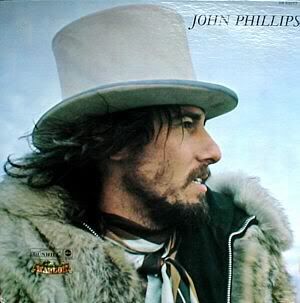
I just listened for the first time to John Phillips' first album after The Mamas and the Papas fell apart, which is sometimes referred to by his name, sometimes as John the Wolfking of LA. This is, as I said before, amazing music. It's in a country-folk style not entirely unrelated to TM&TP's most frequent modes, but feeling utterly different, more like a Tim Buckley or even a Leonard Cohen. The lyrics are, as they were with his band, frequently heartbreaking, but where John, Denny, Michelle, and Cass covered the sorrow with a kind of bombastic sweetness, the very different sweetness here leaves the emotion bare.

Incidentally, a good deal of the sweetness on this album comes from the backing vocals, provided perfectly by the legendary Darlene Love alongside her less legendary but no less delightful colleagues Fanita James and Jean King. Love, James, and King were the three most regular members of The Blossoms, frequent session singers who also recorded some obscure records under their own name, and much better-known songs as Bob B. Soxx & the Blue Jeans and as The Crystals (in some versions; for hints of the Phil Spector-is-terrible story behind that, see here).

Anyway, music can speak for itself, so I'm going to shut up and present "Topanga Canyon."


PS And my god, that piano sound!

*Or technically four, since I don't want to dismiss how awesome Yoko Ono's Plastic Ono Band is, but since she was never in the Beatles it's not directly relevant to what I'm talking about. But: awesome, awesome album.

Wednesday, June 16, 2010

Halfway through Pride Month

I guess once July starts I have to go back to being ashamed?

Tuesday, June 15, 2010

Weird

If digby is, as she says, "immune" to speeches, what the heck keeps her so damn snookered?

Think of the children

Not irrelevant to the post I might eventually write at some point during my lifetime about young people and sex: I see that Perez Hilton could conceivably be charged with distributing child porn, which according to the article carries a mandatory minimum 15 year sentence, for linking to an upskirt underpantsless photograph of seventeen and a half year old Miley Cyrus.

Now, from what the article says, no one is actually charging him as of yet. But I hope we can all see past the natural disgust we feel towards Perez Hilton, and towards the concept of upskirt shots, to see how patently ludicrous even the possibility, even the suggestion, that someone could be imprisoned for fifteen years for not taking, not posting, but linking to a photograph, taken in public, that includes a glimpse of a vagina belonging to a woman half a year away from an arbitrary "age of majority."

I mean, it's absurd to call that porn, let alone criminal child porn. Our society's attitudes about sex are insane. That includes both what I've just described and the attitude that leads to the idea that taking and "distributing" such a picture is desirable. In fact, they're the same fucking attitudes.

Incidentally, I stumbled upon that article because it was linked to in the sidebar of this Greenwald article, which is overall his usual decent quality but which also casually refers to high school seniors as "children." I mean, what is wrong with us?

Monday, June 14, 2010

pass it on

well, we've finally given up being coy and are ready to declare an unbound desire for afghan mineral deposits. hell, let's just consider them ours already. from linked article above:

"[State Department spokesman] Crowley downplayed questions about the potential for other countries to try to exploit Afghanistan's possible wealth and acknowledged that internal corruption could pose a problem...


'We're very mindful of the fact that around the world, you have a number of countries that are blessed with natural resources that may become a source of conflict and corruption,' Crowley said...


'We want to be sure that we have helped Afghanistan develop effective institutions of government so that it's able to develop its mining sector, that it's generating revenue that can be turned into greater prosperity and shared opportunity for the Afghan people,' he said."

Sunday, June 13, 2010

This city was murdered, buy our product

Via io9, I see that Absolut has created an ad (or, sorry, Absolut sponsored an artist's creation, and then put their branding on it for entirely selfless reasons!) in which Picasso's Guernica is, as io9 would have it, "reimagined" as an x-ray. As a work of art it's fine, I guess, though a bit pointless unless I'm missing something. As an advertisement it is reprehensible beyond belief.

Judith Levine, Harmful to Minors, introduction page xxii

(Cross-posted from Commonplace)

Beleaguered parents have only the media and the marketplace as sources of advice and help. The parenting magazines indict a hazard of the month, providing fretful mothers and fathers with a ready list of names for their vaguest fears: television radiation, chlorine, medicine droppers, iron pills, automatic garage door openers, latex balloons, trampolines, drawstring sweatshirts. The newsweeklies chime in with perils of a less concrete, more moral nature. "How Can We Keep Our Children Safe?" asked the cover of Life magazine in the mid-1990s, ringing the vulnerable face of a blond-haired, blue-eyed girl with a boldfaced wreath of horribles: "sexual abuse, abduction, television, accidents, neglect, violence, drugs, vulgarity, alienation." The article, like the pieces on chlorine and sweatshirts, offered few solutions that were not purchasable, and private.

Thursday, June 10, 2010

Why can't I stand up and tell myself I'm strong

On a different subject, Jackie DeShannon:

Good night. Til tomorrow.

Sexually dangerous, belated addendum

So obviously the promised followup to my Sexually dangerous post, focusing on our society's attitudes towards young people and sex, hasn't happened yet. Maybe eventually I'll feel up to the task. But in the meantime, I want to point out something that I didn't say (or even think of) explicitly when I wrote the original post.

In comments, there was quite a bit of back and forth, first between ASP and myself, then between ASP and Richard, and then between ASP and Jack, and eventually I started feeling really bad that it seemed like an argument between ASP on one side and a bunch of dudes on the other. Of course the only person who really got argumentative in the whole thing was me, and that was because a) I was tired and b) I unfortunately conflated what silly Jenny was saying with what sensible ASP was saying, which, sorry about that.

Uh, anyway, now that my absorbing summary of the comment thread is done, what I want to point out is that out of the exchange between Jack and ASP came this statement of Jack's, in response to a summary of a study of rapists:
It contains the beginning of the answer of how to "handle" rapists.

Don't make them.
No one, I think, could disagree with this. The disagreement arose when ASP responded, quite accurately, that feminists have been working on this for quite some time. And it is true, and no matter how minor any individual example may seem, I do think it's valuable to point out examples of how our mass culture reinforces the attitudes that lead to so many men thinking it's perfectly OK for them to do as they please with women, regardless of how the women might feel about it. On all this, I agree with ASP 100%.

However.

These efforts, particularly as I see them at Shakesville but also in other places (and I am not accusing ASP of doing this herself; this is simply a response set off by what she said, hopefully not to be taken as a criticism of her herself), often seem to come hand in hand with the kind of punitive impulse, and the kind of deference to power, that I was clumsily attempting to criticize in my original post (I realized later that I should have split it into two posts, one discussing the ruling itself, one discussing the reaction to it, but my own navel gazing self-criticism is neither here nor there right now).

The problem is that these attitudes, the deference to power and the impulse to punish, are in themselves extremely powerful drivers of the rape culture.

The problem with the deference to power, expressed here by McEwan's bizarrely trusting "sure, there's potential for abuse, but..." framing, expressed elsewhere in her fawning admiration for people like Hillary Clinton and Al Gore, surely needs no explanation. Rape is in large part about expressing power, the rapist declaring his total dominion over the body of the victim. A society with entrenched power structures such as we have, in which we are expected to subsume ourselves to the individuals at the top who present themselves as speaking for us, by its very nature encourages other, violent expressions of power. And this is all without even mentioning the fact that the wielders of American power have encouraged and instituted regimes of systemic rape as a means of control, around the world.

(Another aspect of the power-worship--passively allowing huge corporations to define culture for you--was ably demolished by Jack in the original comments.)

The problem with the punitive impulse as a response to rape should be even more obvious, but somehow it doesn't seem to be. I mentioned in comments to my original post that "rape is itself rampant in prisons." Your good liberal thinks that this is something that could be regulated away; of course I think differently. Rape, as far as I'm concerned, is an integral part of the prison system, a way of ensuring that the power structures that prison serves to reinforce are perpetuated on every level. But even if it's not--even if we could somehow eliminate all traces of rape and sexual assault from prisons--even in this hypothetical (if you ask me, impossible) world, the prison system, and the punitive impulse that leads almost everyone, no matter where they fall on the limited spectrum allowed in mainstream thought, to encourage it, would still reinforce the rape culture.

Opposition to the death penalty is thankfully common among liberals. In discussing it, they often rightly point out the hypocrisy inherent in killing someone as punishment for killing someone. That the implications of this line of reasoning are never explored any further is an indication, again, of how limited the range of mainstream, allowable thought is.

Because surely a moment's reflection would make anyone realize that imprisoning someone (i.e., the use of power to remove someone's agency) as punishment for raping someone (i.e., the use of power to remove someone's agency) is just as hypocritical. And if one's goal is changing the culture that creates rapists, it can only be counterproductive.

I hope it is clear that none of this should be taken as a defense of rapists, nor as an erasure of the fact that, as things stand, rape is a largely consequence-free act as far as the rapist is concerned. And no, I don't have a solution for what we should do with rapists, given that we obviously have a culture that creates them in large numbers. I do know, however, that what we currently do with them, both when we let them go free and when we do punish them, only contributes to creating more and more of them.

UPDATE I'm kind of an asshole. See comments.

Wednesday, June 9, 2010

Quasi-scientific study

This morning I walked two miles, half of it on a main road through a small city, half of it on suburban residential streets. As I did, to amuse myself I decided to keep an eye on the cars driving towards me and count how many carried only one person versus how many carried passengers. Just one passenger was enough to be counted, and I disregarded any vehicle that seemed to be business-related (pickup trucks with logos on the sides, anything bigger than an SUV, that kind of thing), just to be extra-clear.

In the two miles, fifty-one eligible cars passed me. Six carried passengers. The remaining forty-five carried only the driver.

The rapid use of energy that took billions of years to store up is killing us. We know this. In order to get this energy, we've cut bleeding gashes into the earth, all of which, but especially one of them right now, are killing us. We know this. But nothing changes.

And to a certain extent, how could it? Or, rather, how could we change? I'm all for assigning some of the blame to each and every single one of us, and have engaged in some of that myself. But at the same time, our leaders have invested a lot of money and effort over the decades forcing us to behave in the ways that make us responsible. Sure, we could all do better--carpool, say. But our local worlds have been delocalized. Most of us have to drive to work, most of us can't eat without having our food wrapped in plastic and shipped from miles and miles and miles away. And so on and so on and so on.

As far as the cars go, I've often thought that if we need them at all, they should be modular. If you're just driving yourself, you've got a smart car or a motorcycle or something similar. Small, so you're not lugging tons of steel around just to move yourself. Then if you have a passenger, you can add a passenger seat. Or if you have cargo, you can attach a trunk. Of course, decades of engineering have steered us in a direction where designing that would probably be near impossible, even if anyone wanted to.

I don't really have a point. We're fucked and I don't know what to do about. Shocking, I'm sure.

Monday, June 7, 2010

Look who's doddering

Digby thinks Helen Thomas is senile, or something.

UPDATE since I don't want to devote a whole new post to it: The McEwanator feels "obliged" to write a post about it, thank god! And uh, she thinks Thomas's comments were terrible and also talks about her like she's dead.

Press release

Chris Bowers:
I want to make it clear that I know there are still "amateur" independent blogs around. Also, I do not begrudge a single person for taking any of these various routes to professionalism. Hell, I have wanted to be a professional blogger since Kos first began selling ads in late 2003.
You heard it here first: I have never been jealous of Markos Moulitsas, and I will never go pro. No ads here!

That post is up there with the most unintentionally funny things I've ever read.

(via Avedon Carol)

Sunday, June 6, 2010

In happier news

It's getting more and more likely that we're not the only life in the solar system. Hydrogen-breathing, acetylene-eating, methane-pooping microbes on Titan! It's a big maybe, but my god it's beautiful.

Between this, the ease with which life could evolve on Europa given the conditions we know exist there, and the increasingly strong evidence that there may have once been or may even currently be microbial life on Mars, it's a damn near certainty in my mind.

Life may have evolved independently as many as four times just in our solar system alone. That's not even including the entire rest of the universe.

Makes me happy, is all.

Excellently crafted blog comment sentences

hist on SMBIVA:
If I wrote a fictional villain who put out a young art students eye and laughed about how she deserved it, I'd be accused of laying it on too thick.
fred on Tiny Revolution
Israel will always agree with Turkey on this matter: it's simply a coincidence that some Armenians were killed at the same time that other Armenians were being killed.

Saturday, June 5, 2010

Where its due, part whatever

This digby post, unless my reading comprehension is failing me, is shockingly on-target and undeluded.
It’s an article of faith among financial elites across the planet that the welfare state is an abomination and this is a global opportunity to end it. Each culture will deal with it slightly differently --- riots in Greece, marches in France, blog posts in America. But in the end, the result, short of revolution, will be similar everywhere --- the post-war welfare state will be weakened or destroyed. The left is barely relevant anywhere anymore and they simply do not fear any kind of serious populist uprising.

To my fellow East Coasters

Uh, go to the beach while you can.


Projection via Minnesota Public Radio, h/t Johnny Sunshine Jackson in comments.

Friday, June 4, 2010

Redundancy

If you read this blog (you do, don't you?) you probably already read the much more useful Chris Floyd and Arthur Silber and IOZ, which means most likely you've already seen this amazing Washington Post article about how "the Obama administration has significantly expanded a largely secret U.S. war...in 75 countries." But just in case you missed it, here you go. The next time you hear someone talk about how at least Obama's better than Bush was or McCain would have been, or about how America is fundamentally a force for good, or whatever nonsense people like that let fall out of their mouths, point them in the direction of this evil shit.

The best intro before reading the article, I think, is this from Chris Floyd:
[T]he Post is often a very good source of information about the operations and machinations of the militarist empire -- not because its editors are seeking to expose the empire's crimes and atrocities, but because they approve of them. And thus they will often write about them, in detail, in the most straightforward manner: "Hey, look at the cool stuff our boys are doing now!"

As a final note, I would like to point out that a bug just deliberately flew into my nose.

Another post that might confuse JR


Don't worry, though, JR. I'm confused too. The only way I can think to interpret this is saying that capitalism drives the knife of hatred through the heart of human love, but I sincerely doubt that that is the message that B.C., best known for promoting the most virulently capitalist strain of evangelical Christianity, was trying to get across.

Still, I have to admire the strip for getting the word "capitalism" onto the comics page at all. When was the last time that happened? Hell, how often does it show up in the paper, period?

RIP Rue McClanahan

I feel bad being a day late on this, but I wanted to get this video uploaded and that shit takes forever.

The Golden Girls continues to be one of my all-time favorite entertainments; the quality of its specific combination of a writing team, four actors, and a spectacularly useful formula has rarely been equaled. You could say this equally of Bea Arthur, Estelle Getty, or Betty White, but: it never would have worked without Rue McClanahan.

Everyone knows Blanche, or if they don't, it's easy to find her (and they should). I'd like to leave you with something else, though. It's her brief appearance in Starship Troopers, which I have been known to describe as my favorite movie of the 1990s (this isn't always true, depending on my mood, but it's definitely up there). The scene is sadly under a minute and a half long (you can tell it was edited down from a longer take, I'd love to see those deleted scenes) and largely taken up by Denise Richards' antics, but McClanahan's blind weirdo biology teacher is worth it. I love her face in the background of the Denise Richards barf shot.

Thursday, June 3, 2010

Edgar Allan Poe, "Berenicë" first two sentences

(cross-posted from Commonplace)

Misery is manifold. The wretchedness of earth is multiform.

Ronald Reagan, Campaign Speech 1976

"I would like to be president, because I would like to see this country become once again a country where a little six-year-old girl can grow up knowing the same freedom that I knew when I was six years old, growing up in America."

---

"I would like to be a president. I would like to be a six-year old girl. A country can grow to like a six-year-old girl president.

Growing up old in America, where a president can be a six-year-old girl, I knew freedom. Again, I knew freedom... Can I know freedom? I would like to.

'Where can I see this freedom?' In this country. This America, where freedom can grow. Grow up, America!

I would like to see this country become a six-year-old girl once again."

Tuesday, June 1, 2010

Misunderstandings

President...er, former President Horst Köhler of Germany:
A country of our size, with its focus on exports and thus reliance on foreign trade, must be aware that military deployments are necessary in an emergency to protect our interests, for example, when it comes to trade routes, for example, when it comes to preventing regional instabilities that could negatively influence our trade, jobs and incomes.
Whoops! Someone told the truth! And then he resigned!

The funny thing is, Köhler's a politician. So even when he was telling the truth, he was still lying, and doing it all for the wrong reasons:
I regret that my comments in an important and difficult question for our nation were able to lead to misunderstandings.
This is hilarious on several levels. First of all, "able to lead to misunderstandings." I concede that it could just be an awkward translation from the Deutschlandish (he may actually have said that Israel needs to be wiped off the map for all I know), but really, how perfect is that little bit of politicianese?

Second of all, it's funny because most sane human beings would take a statement like "military deployments are necessary in an emergency to protect our [economic] interests" as being definitively unmisunderstandable; that is, your average every day sane human being would hear that an interpret it, correctly, as meaning "We kill people for profit every day, isn't that evil?"

But you see, that's not what Horst meant. For whatever reason, he forgot himself while making those statements. He thought he was talking to his friends; you know, the other shapeshifting reptilians from other dimensions who rule the world. These are not your average every day sane human beings. To them, the statement "military deployments are necessary in an emergency to protect our [economic] interests" means "Who should we kill today in order to maximize our profits?" This is the spirit in which Köhler intended his remarks to be not able to have been regrettably misunderstood. Imagine his surprise when he remembered the species that made up the majority of his audience!

Here's my favorite part of the NYT article:
He complained that some critics had suggested he supported military “missions that are not covered by the Constitution.”

“This criticism lacks any basis,” he said. “It also is lacking in the necessary respect for the presidential office.”
Now let me get this straight. The mere suggestion that he might have suggested breaking the Constitution is "lacking in the necessary respect" for the office of the President of Germany?!?! Well, sieg heil, I mean really.

Some added funny is that while I am no expert in the intricacies of the German political system, it is my understanding that the President is pretty much a ceremonial figurehead. So I'm like, exactly how much respect is necessary, when we really get down to it? (Answer: None now, he's not the President any more!)

Everyone stop trying!

For reasons not unrelated to what JR says about Greenwald, I don't feel that I have anything useful to say about the Israeli massacre of relief workers en route to Gaza. If only this same reservation would stop others from feeling the need to chime in on it, maybe we'd hear less about how, OK, maybe it's Israel's fault, but it's the malevolent dead folks' fault too, and about how wanting to help people who are being throttled to death is not "peaceful," and how when armed troops started boarding their ship if they really hadn't wanted to get shot they would have just stood around and waited for the men with guns to attack them, and how, yes, it is still mostly Israel's fault, but all in all it was just a "hawkish" "screw up." No big deal, really, unless it turns out, as it "possibly" will, that it was a war crime, whatever the fuck that is. It's really amazing that the shooting didn't start sooner! Way to go, IDF!

The last sentence, though, I can agree with:
Sometimes I think that Netanyahu would be better defender of Israel if he just stopped trying.
Because yes, in general if you stop "trying" to murder thousands of people for profit, you don't usually have to do much to defend yourself against them.